Therese Schwartze, born on 20 December 1852
Showing posts with label Dutch painters. Show all posts
Thursday, 20 December 2012
Friday, 7 December 2012
Sunday, 2 December 2012
Tuesday, 20 November 2012
Pieter de Hooch and A Farm Servant In The Backyard
Pieter de Hooch, born on 20 November 1629
Due to the NaNoWriMo Project, I will continue to post a painting a day for the month of November but I won't have time to write. I may add text at a later date. I hope you will still visit to see the daily painting.
Monday, 19 November 2012
Jan Baptist Weenix and Figures Among Ruins
Due to the NaNoWriMo Project, I will continue to post a painting a day for the month of November but I won't have time to write. I may add text at a later date. I hope you will still visit to see the daily painting.
Thursday, 1 November 2012
Hendrick ter Brugghen and Melancholia or Mary Magdalene
Hendrick ter Brugghen, born in 1588 and died on 1 November 1629
Due to the NaNoWriMo Project, I will continue to post a painting a day for the month of November but I won't have time to write. I may add text at a later date. I hope you will still visit to see the daily painting.
Wednesday, 31 October 2012
Johannes Vermeer and Girl With A Pearl Earring
![]() |
| 'Girl With A Pearl Earring' (c. 1665) by Johannes Vermeer; Mauritshuis, The Hague |
I guess on the list of most famous Dutch painters, next to Rembrandt and Van Gogh, ranks Johannes Vermeer, baptised on 31 October 1632 (no record of his actual date of birth). His Girl With a Pearl Earring is his masterpiece and world famous, sometimes referred to as 'The Dutch Mona Lisa'. To see it in closer detail, click here and once again to enlarge it. It is indeed beautiful, but not my favourite painting by Vermeer and also not my favourite painting of the collection of the wonderful Mauritshuis in The Hague. I have visited the museum numerous times now and can recall the first time I saw the Girl with the Pearl Earring. I thought it was beautiful but I was also a bit disappointed. It is such a famous painting that when I looked at it for the first time in real life, it didn't hold any surprises. It was just the way I had seen it in art books and reproductions. This might sound terrible to art connoisseurs but that's how I experienced it. The blue wasn't more startling (Vermeer preferred to use cool tones of blue), nor the intimate look in the girl's eyes. For instance, I find a Rembrandt painting always a bit of a surprise seeing it in real life, because his dramatic use of light can never be matched in a reproduction. Anyway, I hope I didn't offend any fervent fans of this particular painting. About the man himself, I only want to mention the following and the rest you can read by clicking on his name above. Vermeer was known for his paintings of domestic interior scenes of middle class life and only produced forty or so paintings. He stayed relatively unknown during his brief lifetime and it wasn't until the 19th century that he got recognition and appreciation for his work. Of course I could have chosen another painting by Vermeer, like Diana and Her Companions (also to be seen at the Mauritshuis) or the The Milk Maid or the beautiful The Lacemaker, all of which I like better than the Girl with the Pearl Earring. But I guess I want to post this masterpiece to appreciate its beauty more. Click here for a list of Vermeer's paintings.
Wednesday, 24 October 2012
Jan Lievens and Study Of An Old Man
![]() |
| 'Study Of An Old Man' (c. 1629) by Jan Lievens; Private Collection |
There were two Dutch painters to choose from today. Jan Lievens, who was born on 24 October 1607, and Gabriël Metsu, buried on the 24th of October, 1667. They were even contemporaries. I just read their biographies online and found out that they were both born in Leiden. Lievens died in Amsterdam and Metsu was buried there (there's no information on the date or location of his death). As much as I like Metsu and in particular this painting of a Man Writing a Letter, I choose Jan Lievens for this post. If you follow this blog, you get a sense of what paintings I like and lots of times those are of beautiful women. But I also love paintings of old men, in the way that Ribera and Rembrandt have painted them. Of course Rembrandt was the master in painting old men (I love this painting) but today's painter Lievens comes very close. You will notice similarities between Lievens and Rembrandt and this is not surprising since Lievens was a student of Pieter Lastman who was Rembrandt's teacher. Lastman paid a lot of attention to painting features like hands, feet and faces, and these are also very apparent in the paintings of Lievens and Rembrandt. Lievens shared a studio with Rembrandt from about 1626 till 1631 in Leiden and they became friends. I have visited the exhibition on Jan Lievens at the Museum Het Rembrandthuis in Amsterdam in 2009, and it was actually the first time that I got introduced to his work. Today's painting of a study of an old man, he probably painted in 1629, when he and Rembrandt were making studies on old age. I think it is beautiful. It was put up for auction at Sotheby's in London in 2010, together with a painting by Frans Hals. The estimated price for both paintings was between 2,25 and 3,37 million euros.
Saturday, 20 October 2012
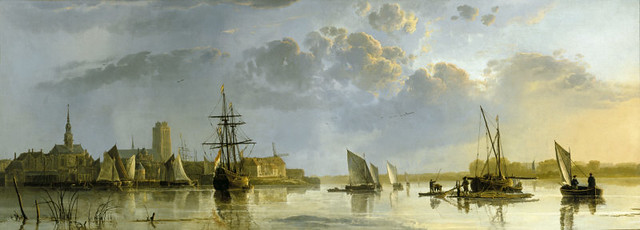
Aelbert Cuyp and View of Dordrecht
| 'View of Dordrecht' (c. 1650) by Aelbert Cuyp; The Anthony de Rothschild Collection, Ascott House, Buckinghamshire |
Today there was not much to choose from but I am happy to do a post on Dutch painter Aelbert Cuyp, born on 20 October 1620, even though I am not a huge fan of his work. I do like his use of light a lot though. Cuyp was born in Dordrecht, a small provincial town in The Netherlands, and was one of the most important landscape painters of the 17th century, the Dutch Golden Age. He lived and worked in his native town and in his early landscape paintings, the influence of Jan van Goyen is evident in its grey-green palette. In the 1640s, his landscape style transformed when he met Utrecht artist Jan Both who had developed a different style after his stay in Italy. Cuyp had never visited Italy himself but from now on he bathed his paintings in golden Italian sunlight. Besides the role that light played in his work, animals were a main feature in his landscape paintings. Most people in The Netherlands know Cuyp, even if they have never heard of the painter. The Albert Cuyp streetmarket in Amsterdam is probably the most well-known and most popular market in the country. I like the light of the setting sun in today's painting and the calm and friendly atmosphere.
Saturday, 13 October 2012
Caesar van Everdingen and Winter
| 'Winter' (c. 1650) by Caesar van Everdingen; Rijksmuseum, Amsterdam |
There was no doubt in my mind to dedicate today's post to Caesar van Everdingen, buried on October 13, 1678 (no exact date of his birth nor death is known). Because his painting known as Winter (full title 'Young Woman as Winter' or 'Young Woman warming her Hands') is one of my favourite paintings of the permanent collection of the Amsterdam Rijksmuseum and I am very happy to show it to you here. But in my post of 6 September on the painter Julius LeBlanc Stewart I had made mention of the wonderful artist John Atkinson Grimshaw whom I had just discovered, and I had hoped to be able to use him for today. But then I found out about Van Everdingen and as much as I like Grimshaw's work (like Spirit of The Night and his nightscenes like this and this and this which are stunning) and would love to dedicate an entire post to him (maybe if I continue this blog, next year), the beauty of Van Everdingen's 'Winter' wins out anytime. Also because I have seen this in real life and it is so beautiful. The painting depicts a young woman warming her hands over a pot with glowing coals. She is the personification of winter. I love all the exquisite details. The maker of this wonderful painting Van Everdingen had worked under Jacob van Campen. Through him he received some important commissions. He painted mainly historical paintings and portraits.
Thursday, 11 October 2012
Barend Cornelis Koekkoek and Portrait of A Young Lady
![]() |
| 'Portrait of A Young Lady' (1846) by Barend Cornelis Koekkoek; B.C. Koekkoek-Huis, Kleef |
Dutch painter Barend Cornelis Koekkoek, born on 11 October 1803, was the first painter on my list to check for paintings. I had never heard of him before so didn't know what to expect or whether to like his work. When I googled the images of his paintings, all I initially saw were landscapes. There are some that are beautiful like The Coming Storm but then my eyes were drawn towards the only portrait standing out amidst all those landscapes. And it's a beautiful portrait! Koekkoek was born into a family of painters and studied under his father. He attended the Amsterdam Academy of Art and travelled through Belgium and Germany where he got inspired by the landscape. In 1841, he founded his own art academy. He was a very succesful painter and achieved considerable fame during his lifetime. The portrait chosen for today is indeed exceptional in his oeuvre. Although the focus is on this beautiful young woman, the landscape plays an important role as well, providing the backdrop for the main subject.
Sunday, 7 October 2012
Isaac Israëls and Reading Girl On A Sofa
![]() |
| 'Reading Girl On A Sofa' (1920) by Isaac Israëls; no location found |
It's always nice to be able to do a post on a Dutch painter (because I'm Dutch) and I am happy to introduce you today to Isaac Israëls, born on 3 February 1865 and died on 7 October 1934. He was linked to Amsterdam Impressionism, an art movement of the late 19th century, mainly associated with the great Dutch painter George Hendrik Breitner. Israëls was the son of the painter Jozef Israëls, who was one of the most famous artists of the Hague School, and studied at the Royal Academy of Art in The Hague where he met Breitner. They became lifelong friends. Israëls's passions were painting, travel and literature, and he painted portraits, city views, and women. He often spent his summer holidays at the Dutch seaside resort of Scheveningen with his father and they would invite guests like Édouard Manet and Max Liebermann. Born in Amsterdam and died in The Hague, his work has an Amsterdam period as well as a The Hague one. There were major exhibitions in Amsterdam and The Hague over the summer months and I regret having missed them. I just haven't been paying close attention to what was going on artwise in the last few months (other than the Impressionist exhibition at the Hermitage, Amsterdam, which I háve visited, and will visit again in the coming month because it is wonderful). Anyway, these are the exhibitions that I've missed: one at the Stadsarchief in Amsterdam about Israëls's work in Amsterdam, and one at several museums in The Hague about his The Hague period. I don't even want to look closely at the links I've just provided you with, because I can kick myself for having missed the exhibitions.
Friday, 17 August 2012
Jacob Backer and Portrait of Rebecca Schellingwou
![]() |
| 'Portrait of Rebecca Schellingwou' (1644) by Jacob Backer; Amsterdam Museum |
Today I found my painter quickly. Jacob Backer, born in 1608 and died on 17 August 1651, was a Dutch painter from the Golden Age. I have attached the link to the Dutch Wikipedia page which mentions the 17th of August as the date of his death, whereas the English page says the 27th. I'm going to stick to the Dutch page because I can't be bothered looking for another painter for today because of conflicting dates. I have seen an exhibition on Backer at Museum Het Rembrandthuis in Amsterdam (the exhibition ran from 29 November 2008 till 22 February 2009) and really liked it. Amongst the paintings that were on display were two masterpieces from the collection of the Amsterdam Museum, formerly Amsterdam Historical Museum: the portraits of Bartholomeus Breenbergh and Rebecca Schellingwou who were husband and wife. I especially liked the painting of Rebecca Schellingwou. The colours are beautiful and Backer is a master in painting fabrics. He was mainly active in Amsterdam and had a successful career. He had studied in Leeuwarden and was a fellow student of Govert Flinck. Together they went to Amsterdam where Flinck alone studied under Rembrandt. It was believed, incorrectly, that Backer also had studied with Rembrandt. There is little known of his life. He never married, never painted a landscape, never was the subject of any gossip or scandal. He worked extremely fast and his work can be characterised by a vivid use of colour. He was one of the most famous painters in Amsterdam at the time and he died when he was in his early forties.
Sunday, 12 August 2012
Jozef Israëls and Meditation
![]() |
| 'Meditation' (1850) by Jozef Israëls; Dordrechts Museum, Dordrecht |
Today I can do a post on a Dutch painter again. Jozef Israëls, born on 27 January 1824 and died on 12 August 1911, was one of the most important painters of the Hague School (Haagse School). The Hague School was heavily influenced by the French Barbizon School. If you see the images of Israëls' paintings together, you recognise the Realist style that both schools are known for. Israëls studied art in Groningen, Amsterdam and Paris. After an illness, he went to the fishing-town of Zandvoort to recover and started painting fishermen and beach scenes. Today's painting is called 'Mijmering' in Dutch. The English equivalent would be 'reverie' but I found one mention of an English translation of the title and they used 'Meditation' so I do as well. The painting is very different from his other work. It reminded me immediately of Ary Scheffer whose work is also to be seen in the Dordrechts Museum. In fact, the museum has the biggest collection of Scheffers' work in The Netherlands. I read somewhere that the painting 'Meditation' (that has undergone a major restoration) is the key piece of the museum's collection because it connects the French-Romantic style of Scheffers' paintings with Israëls' 19th century realistic work and that of his contemporaries. I find this painting beautiful! Great light! I have to go and see it and Scheffer's work as well.
Thursday, 9 August 2012
Hieronymus Bosch and Triptych of Garden of Earthly Delights (detail)
![]() |
| 'Triptych of Garden of Earthly Delights' (c.1480-1505) by Hieronymus Bosch; Museo del Prado, Madrid |
The Garden of Earthly Delights by Dutch painter Hieronymus Bosch, born c. 1450 and died on 9 August 1516, is a painting that's truly one of a kind. I have never seen anything like it. When I was at the Prado in Madrid some years ago, I entered a room and stumbled upon a huge crowd standing in front of a painting. I couldn't see what painting it was and wondered what could interest such an audience. Well, it's this painting. It's totally different from what I usually like. Maybe 'like' here is not even an adequate word. It's mesmerising, it's a masterpiece, it's mind-boggling really. There is so much to see and it's unbelievable that Bosch painted this in the fifteenth century. He had an immense imagination and eye for detail. This is a painting that one never gets tired of. I'm planning to go to Madrid this or next year and will go and see the painting again. I'll make sure I will read about it first. The Wikipedia page (click link above) gives a lot of information on the painting and the painting is also being displayed in Google Earth. If you are curious about its painter, there's a link above as well.
Wednesday, 1 August 2012
Jan van Scorel and Maria Magdalene
![]() |
| 'Maria Magdalene' (c. 1530) by Jan van Scorel; Rijksmuseum, Amsterdam |
Today there was not a whole lot to choose from that was to my liking. But then I stumbled upon Dutch painter Jan van Scorel, born on August 1, 1495 (see his Dutch Wikipedia page for the date). I know this painter by name but never knew exactly what kind of paintings he had made. Nor did I know that he was responsible for introducing Italian High Renaissance art to The Netherlands. He was one of the first Dutch painters to visit Italy and got acquainted with the work of Michelangelo and Raphael. He painted mostly portraits or works with a religious theme. Today's painting 'Maria Magdalene' is actually not oil on canvas but was painted on a panel, like most paintings in the 15th and 16th centuries. In the late 16th century artists started to work more on canvas. Because panels were made of wood, and wood tends to warp over time as a result of changes in temperature and humidity, a top plank had been added to the panel after Van Scorel's time (just above the head of Maria Magdalene). The addition of the extra plank and thus extra blue sky reduced the tension and power of the composition and made the image of Maria Magdalene less strong. Click here for the original (smaller) painting. The size of the original was also more in line with Van Scorel's other paintings which were broader in size. This painting belongs to the collection of the Rijksmuseum, Amsterdam, but Wikipedia names the Frans Hals Museum in Haarlem as current location. Since the Rijksmuseum is still being renovated and won't open until next year, the painting had been on loan to the Frans Hals Museum. I couldn't find on the internet whether it is still on display in Haarlem.
Saturday, 28 July 2012
Judith Leyster and The Proposition
![]() |
| 'The Proposition' (1631) by Judith Leyster; Mauritshuis, The Hague |
Judith Leyster, born on 28 July 1609, was one of the few female painters of the Dutch Golden Age, at least still known to us. She painted genre scenes, portraits and still lifes and was influenced by Frans Hals and the Utrecht Caravaggisti. She was very succesful in her day and one of the few female members of the Haarlem Painters' Guild. She also took on students of her own. The story goes that she sued Hals succesfully for a breach of ethics after he stole one of her students. The artwork I chose for today is probably Leyster's most well-known painting. 'The Proposition' is a genre scene from everyday life. Leyster depicted a man offering money to a woman who is doing needlework. The man's seductive smile, the coins in his hand and the intimate candlelight might suggest that the man is offering money for love. This was a popular theme in Dutch painting. But nothing else in this work of art indicates that this might be a brothel scene (no cheerfulness, revealing clothing, hidden sexual symbols, etc.). The woman doesn't seem to be interested in what the man has to offer. Even more, she ignores him and doesn't look up from her needlework. It could have been just a domestic scene if it weren't for the coins in the man's hand. Leyster might have wanted to show the woman's virtue and strong character with this ambiguous work. I think this is a great painting from a great feminist painter who lived in a time when women were suppressed and uneducated.
Sunday, 15 July 2012
Rembrandt van Rijn and Jeremiah Lamenting the Destruction of Jerusalem
Due to my stay and volunteer work in Peru for most of June and July, I won't have time to write but I will continue to post a painting a day. I may add text upon returning to Amsterdam. I hope you will still visit to see the daily painting.
Saturday, 14 July 2012
Willem Bartel van der Kooi and The Wet Nurse
Due to my stay and volunteer work in Peru for most of June and July, I won't have time to write but I will continue to post a painting a day. I may add text upon returning to Amsterdam. I hope you will still visit to see the daily painting.
Tuesday, 10 July 2012
Hendrik Willem Mesdag and Setting Sun
Due to my stay and volunteer work in Peru for most of June and July, I won't have time to write but I will continue to post a painting a day. I may add text upon returning to Amsterdam. I hope you will still visit to see the daily painting.
Subscribe to:
Posts (Atom)