

Showing posts with label Pre-Raphaelites. Show all posts
Showing posts with label Pre-Raphaelites. Show all posts
Wednesday, 26 December 2012
Saturday, 22 December 2012

Thursday, 13 December 2012

Monday, 5 November 2012
Edward Robert Hughes and Midsummer Eve
%20(1).jpg)
Edward Robert Hughes, born on 5 November 1849
Due to the NaNoWriMo Project, I will continue to post a painting a day for the month of November but I won't have time to write. I may add text at a later date. I hope you will still visit to see the daily painting.
Tuesday, 16 October 2012
Frank Cadogan Cowper and Vanity
+-+Vanity.+1907.jpg) |
| 'Vanity' (1907) by Frank Cadogan Cowper; Royal Academy of Arts, London |
Today's painting I had already drafted some time ago because I think it is beautiful and I didn't want to use another painting for this date and miss out on this one. The artist Frank Cadogan Cowper, born on 16 October 1877, is described as the last of the Pre-Raphaelite painters and he's someone I had never heard of before. He took his subjects from literature, history and religion, painted in the Pre-Raphaelite style with close attention to colour and detail. Look at Vanity. Aren't the colours and details gorgeous? Cowper attended the Royal Academy Schools and exhibited his work there for the first time. In 1910, he received a commission to paint a mural for the House Of Commons. He moved to the States during the Second World War but returned to England in 1944. He continued to paint and exhibit until 1957.
Saturday, 6 October 2012
Ford Madox Brown and The Last of England
.jpg) |
| 'The Last of England' (1855) by Ford Madox Brown; Birmingham Museum and Art Gallery, Birmingham |
Although very much a Pre-Raphaelite painter in style and colour, English artist Ford Madox Brown, born on 16 April 1821 and died on 6 October 1893, was never a member of the Brotherhood. He became closely involved with the movement because of his friendship with Dante Gabriel Rossetti. Born in Calais, he had been regarded as an outsider in the British art world, even though his parents were British. He studied drawing in Europe and became friends with German painters of the Nazarene movement. His work bears the influence of Johann Overbeck and Peter von Cornelius. During his life, Brown never made much money out of painting and he was largely ignored by his contemporaries. He had problems finishing his paintings and would retouch them constantly, even after they had been sold. Today's painting The Last of England is actually the only painting by Brown that I myself am familiar with, probably because it's his most famous work. It is an image of a couple of immigrants leaving England forever. The expression on their faces tell you their state of mind on leaving and I think Brown succeeded in making this a very strong depiction.
Tuesday, 25 September 2012
Arthur Hacker and Lost Parasol
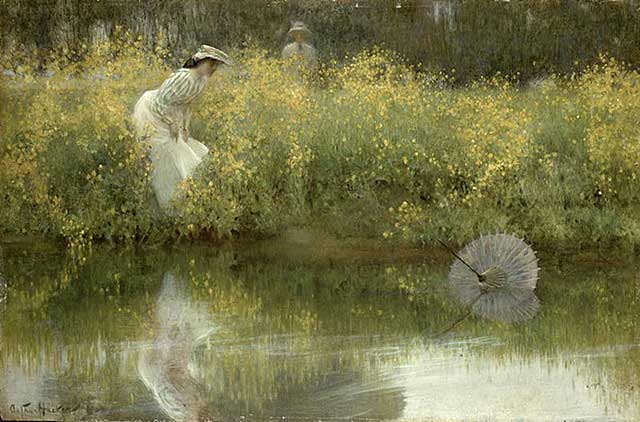 |
| 'Lost Parasol' (1902) by Arthur Hacker; Private Collection |
I so love doing this blog! I had never heard of Pre-Raphaelite painter Arthur Hacker, born on 25 September 1858. I just discovered him and am happy to use him for this post. Hacker studied at the Royal Academy schools before going to Paris. There he studied under French painter Léon Bonnat who was well-known for his portraits and a friend of Edgar Degas. Hacker became a painter of portraits and historical and religious scenes. He also painted mythological and allegorical subjects. The Wikipedia page (click on author's name) mentions that Hacker is a Classicist painter but doesn't say anything about him being part of the Pre-Raphaelite circle. I think some of his paintings are very much in the Pre-Raphaelite style like The Temptation of Sir Percival or The Drone, and I found many mentions of him being a Pre-Raphaelite painter (click here for a list of Pre-Raphaelite painters). I chose today's painting because apart from portraits, I also like narrative paintings a lot. Looking at this lighthearted scene, it makes you wonder whether the woman will be able to retrieve the parasol without getting her feet wet and why the man in the background isn't helping her.
Thursday, 13 September 2012
Anna Lea Merritt and Eve
 |
| 'Eve' (1885) by Anna Lea Merritt; Private Collection |
Today's painter is unknown to me and is Anna Lea Merritt, born on 13 September 1844, who strangely enough only has a Polish Wikipedia page. You can use the translate button, or click here or here for an English article. Merritt was an American Pre-Raphaelite female painter who went to Europe to study art. By the mid 1870s, she had regular exhibitions at the London Royal Academy. She married her English teacher Henry Merritt in 1877 and quit her career as a result. After his death only three months later, she resumed painting. Her painting Love Locked Out (1889) became the first work by a woman artist to be purchased by the Tate Gallery in 1890. Today's artwork, also known as 'Eve overcome by remorse', has attracted the most attention of her exhibited paintings. It won accolades at the Chicago exhibition in 1893. I think it's beautiful.
Saturday, 1 September 2012
Edmund Blair Leighton and God Speed!
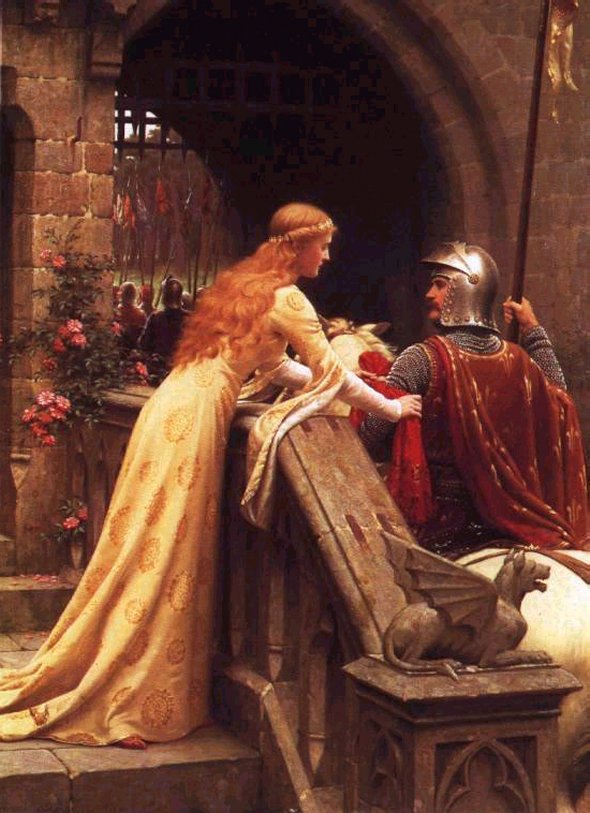 |
| 'God Speed!' (1900) by Edmund Blair Leighton; Private Collection |
Today I can do a post on British painter, Edmund Blair Leighton, born on 21 September 1852 and died on 1 September 1922. I don't think that he was officially a Pre-Raphaelite painter but he was associated with the Brotherhood and his paintings are also medieval and Arthurian in theme. Today's painting looks definitely Pre-Raphaelite in style and colour to me. I wasn't familiar with this painter or his work and his name is not commonly known but apparently his paintings 'God Speed!' and The Accolade are amongst the most widely recognised paintings of the period. I absolutely love both this painting and 'The Accolade'. 'God Speed!' is a depiction of a romantic scene between the beautiful maiden and her knight in shining armour. We feel the immediate danger and even hope for his safe return. Leighton also specialised in Regency paintings, like this one and this one. They are lovely but maybe a bit too sentimental and sweet. I do like his Pre-Raphaelite paintings much better with the Arthurian theme and vivid colours. To see more, click here and here and here.
Tuesday, 14 August 2012
Simeon Solomon and The Sleepers and the One who Watcheth
 |
| 'The Sleepers and the One who Watcheth' (1870) by Simeon Solomon; Birmingham Museums and Art Gallery, Birmingham |
Another Pre-Raphaelite painter unknown to me. Simeon Solomon, born on 9 October 1840 and died on 14 August 1905, met Dante Gabriel Rossetti and joined the circle of the Pre-Raphaelite painters. He struck up a close friendship with Edward Burne-Jones. His early work are mainly depictions of religious subjects and slowly he began to show subtle traces of his homosexuality in some of these paintings. After he joined the Pre-Raphaelites, the expression of his sexuality in his work began to increase considerably. In the 1860s he began to focus on the female figure which reveals his awareness of aesthetic taste. In 1873 he was arrested with another man for indecent behaviour and sentenced to 18 months of hard labour. He only served two weeks of his sentence before being bailed out. His brilliant career was cut short due to the intolerance of Victorian society. It was now impossible for him to exhibit or sell his paintings. Despite the scandal and the end of his public career, he never stopped working. In the painting chosen for today, we see a couple sleeping while an angel watches over them. It is very reminiscent of Edward Burne-Jones in the way he depicts the androgynous figures. I think it´s beautiful!
Thursday, 2 August 2012
John Roddam Spencer-Stanhope and Love and The Maiden
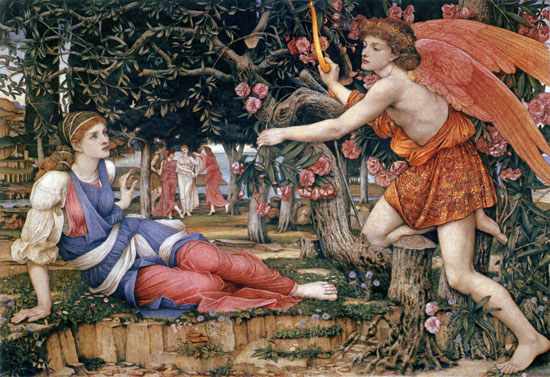 |
| 'Love and The Maiden' (1877) by John Roddam Spencer-Stanhope; Fine Arts Museum, San Francisco |
English painter John Roddam Spencer-Stanhope, born on 20 January 1829 and died on 2 August 1908, is unknown to me and belonged to the second-wave Pre-Raphaelites that also included Evelyn De Morgan. Stanhope was De Morgan's uncle and teacher. He was a friend of Edward Burne-Jones and influenced by him, although Stanhope used stronger colours in his work. He loved the Tuscan landscape and Florentine art and later in life moved to Florence due to health problems. In the painting chosen for today, 'Love and the Maiden', which is considered to be his masterpiece, he pays tribute to 14th century Florentine art. By this date he already lived in Italy permanently. He had access to famous paintings by Italian masters. This painting is based on the Annunciation and the angel Gabriel has been substituted by the winged Eros. The maiden in Stanhope's painting is very similar to the female figure in Botticelli's Venus and Mars. 'Love and The Maiden' was bought at Christie's in 1997 for the sum of 727,500 British Pounds by an Australian art collector. In 2003 he sold it at a profit to the Trustees of the Fine Arts Museum of San Francisco (for the California Palace of the Legion of Honor which is part of the museum). As you might know, I love Pre-Raphaelite art and I am glad to get to know another painter belonging to the group.
Monday, 25 June 2012
Frederick Sandys and Mary Magdalene

Due to my stay and volunteer work in Peru for most of June and July, I won't have time to write but I will continue to post a painting a day. I may add text upon returning to Amsterdam. I hope you will still visit to see the daily painting.
Sunday, 17 June 2012
Edward Burne-Jones and the Beguiling of Merlin

Due to my stay and volunteer work in Peru for most of June and July, I won't have time to write but I will continue to post a painting a day. I may add text upon returning to Amsterdam. I hope you will still visit to see the daily painting.
Friday, 8 June 2012
John Everett Millais and The Black Brunswicker

John Everett Millais, born on 8 June 1829 and died on 13 August 1896
Due to my stay and volunteer work in Peru for most of June and July, I won't have time to write but I will continue to post a painting a day. I may add text upon returning to Amsterdam. I hope you will still visit to see the daily painting.
Saturday, 12 May 2012
Dante Gabriel Rossetti and Veronica Veronese
 |
| 'Veronica Veronese' (1872) by Dante Gabriel Rossetti; Bancroft Collection, Delaware Art Museum, Delaware |
What a splash of absolutely gorgeous colours! Sometimes I wish I was a redhead and I would only wear green! Dante Gabriel Rossetti, born on 12 May 1828, was one of the major Pre-Raphaelite painters and co-founder of the brotherhood, together with William Holman Hunt and John Everett Millais. Don't be misled by his Italian sounding name, for Rossetti was an English artist. Although further reading made me discover that his father was an Italian patriot exiled to England. Rossetti was put off by his father's strong political beliefs. He came to believe that literature and art should pursue beauty for the sake of beauty. This was one of of the key elements of Pre-Raphaelite art: embracing art for art's sake. Dante was also a poet and wrote poetry for the group's magazine 'The Germ'. His personal life and his art were closely related for he had relationships with his models and muses. In 1860, he married his model Elizabeth Siddal. She also modelled for the famous painting 'Ophelia' by John Everett Millais. Their marriage was short-lived. In 1862, Elizabeth died as a result of an overdose of laudanum, leaving Rossetti overcome with grief. For today's painting, 'Veronica Veronese', Rossetti portrayed one of his favourite models Alexa Wilding in a passionate reverie. Rossetti's women were exquisitely beautiful, composed and undisturbed, and very powerful in presence. I love this painting!
Sunday, 6 May 2012
'When Apples were Golden and Songs were Sweet' by John Melhuish Strudwick
 |
| 'When Apples were Golden and Songs were Sweet' (c.1906) by John Melhuish Strudwick; Manchester Art Gallery, Manchester |
Today I discovered another Pre-Raphaelite painter unknown to me, John Melhuish Strudwick, born on 6 May 1849. In the 1870s, he worked as a studio assistant to Edward Burne-Jones and this is reflected in his art style. His paintings are a mixture of Renaissance and medieval styles and show precise attention to detail, especially in his treatment of fabrics and accessories. His use of deep colours is inspired by the Pre-Raphaelites and Burne-Jones. Some of his paintings wear beautiful poetic titles like 'Thy Music, faintly falling, dies away, Thy dear eyes dream that Love will live for aye', or like the full title of today's painting 'When Apples were Golden and Songs were Sweet, but Summer had Passed Away'.
Wednesday, 2 May 2012
Evelyn De Morgan and The Prisoner
 |
| 'The Prisoner' (1907) by Evelyn De Morgan; De Morgan Centre, London |
I like discovering Pre-Raphaelite painters unknown to me and so far I hadn't come across a female one. But today I discovered Evelyn De Morgan, born on 30 August 1855 and died on 2 May 1919. De Morgan was part of the circle of Pre-Raphaelites that included Edward Burne-Jones and it is evident that she was influenced by his work. But in addition to the themes and subjects that the Pre-Raphaelites are known for, De Morgan focused more on allegorical and symbolic themes and subjects. The painting shown here of a woman imprisoned, is a sharp commentary on the position of women during the Victorian and Edwardian eras.
Monday, 30 April 2012
Philip Hermogenes Calderon and Broken Vows
 |
| 'Broken Vows' (1857) by Philip Hermogenes Calderon; Tate Britain, London |
Again a painter that I had never heard of before. Philip Hermogenes Calderon, born on 3 May 1833 and died on 30 April 1898, was an English painter of French and Spanish ancestry. When you google his paintings, you can see that he was influenced by the Pre-Raphaelite style. His later work was dominated by historical, biblical and literary themes. The painting I chose for today is one of his earlier works and here the influence of the Pre-Raphaelites is very evident in the deep colours of the painting. This is probably his most famous work and is on permanent display in the Tate Britain in London. In this painting a woman is shown in agony while being confronted with her lover's adulterous behaviour behind the fence. The ivy-covered wall may suggest that she thought that their love was everlasting because ivy represents fidelity and wedded love. I think the painting is beautiful and quite sad. It makes you truly sympathise with her.
Wednesday, 11 April 2012
John Collier and Lady Godiva
 |
| 'Lady Godiva' (c.1898) by John Collier; Herbert Art Gallery & Museum, Jordan Well, Coventry |
English artist John Collier, born on 27 January 1850 and died on 11 April 1934, studied under Sir Edward Poynter and later under Sir Lawrence Alma-Tadema. He also got introduced to the work of John Everett Millais and painted in the Pre-Raphaelite style. He became a popular portrait painter in Victorian and Edwardian England. His primary subjects were beautiful women of myth, legend and literature. I have heard of John Collier but didn't know whether he was a great painter or what paintings he had made. But this painting of Lady Godiva seems familiar. It is beautiful. Great colours, body and hair. If you wonder what the story with Lady Godiva was again, click here.
Friday, 6 April 2012
John William Waterhouse and The Lady of Shalott
 |
| 'The Lady of Shalott' (1888) by John William Waterhouse; Tate Britain, London |
I knew that the day that John William Waterhouse was born, 6 April 1849, was coming up (though the English Wikipedia page mentions 6 April as the day he was baptised), and had plenty of time to think about what painting to use for this post. I find so many of his paintings beautiful so it was a bit difficult. I say that of a lot of artists but when I say it's difficult with Waterhouse, then I mean Difficult with a capital D. I already loved his work before having seen an exhibition at the Groninger Museum in Groningen in 2009. It is one of the best oeuvre exhibitions I have ever seen in my life. I have to say that the museum had paid attention to detail. Even the marzipan layer on the cake in the museum's restaurant had the image of one of Waterhouse's paintings on it. Waterhouse was a Pre-Raphaelite painter and depicted mainly women from Greek mythology or Arthurian legend. For this post I chose 'The Lady of Shalott' (see another post on the Lady of Shalott by Holman Hunt). It is beautiful here on screen but in real life it is breathtaking. The colours and details are stunning and the moment depicted here is dramatic. It is the moment that the Lady of Shalott drifts in her boat to Camelot but dies before reaching it. For further reading, see the Tate site.
Subscribe to:
Posts (Atom)