Alfred Zoff, born on 11 December 1852
Showing posts with label landscapes. Show all posts
Tuesday, 11 December 2012
Friday, 16 November 2012
John Arnesby Brown and The Dutch Windmill
John Arnesby Brown, born on 29 March 1866 and died on 16 November 1955
Due to the NaNoWriMo Project, I will continue to post a painting a day for the month of November but I won't have time to write. I may add text at a later date. I hope you will still visit to see the daily painting.
Sunday, 28 October 2012
Lowell Birge Harrison and November
![]() |
| 'November' (1881) by Lowell Birge Harrison; Musée des Beaux-Arts, Rennes |
Today's painter, Lowell Birge Harrison, born on 28 October 1854, and his painting November, I know from the exhibition Illusions of Reality (8 October 2010 - 16 January 2011) at the Van Gogh Museum in Amsterdam. I thought it was one of the most beautiful paintings of the exhibition. Large in size and beautiful in colour, my gaze was drawn to it the moment I walked into the room. November is drawing near on the actual calendar so this painting might put you in the mood for an autumn walk in the woods. Before the exhibition, I had never heard of Harrison. He was an American painter and an advocate of Tonalism. In the 1870s, he met John Singer Sargent who persuaded him to come to Paris to study art. He stayed there for six years and exhibited at the Paris Salon with his painting 'November' in 1882. It became one of the first paintings by an American artist to come into the possession of the French government. Harrison was known for his poetic winter landscapes and street scenes. When you google the images of his paintings, there are many that are beautiful. Like Grand Central And The Biltmore In Hazy Twilight and Moonlight River and Fifth Avenue at Twilight. Please click here for more.
Saturday, 20 October 2012
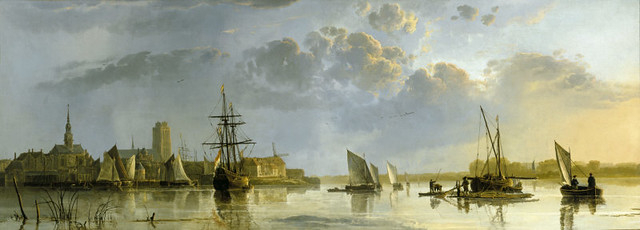
Aelbert Cuyp and View of Dordrecht
| 'View of Dordrecht' (c. 1650) by Aelbert Cuyp; The Anthony de Rothschild Collection, Ascott House, Buckinghamshire |
Today there was not much to choose from but I am happy to do a post on Dutch painter Aelbert Cuyp, born on 20 October 1620, even though I am not a huge fan of his work. I do like his use of light a lot though. Cuyp was born in Dordrecht, a small provincial town in The Netherlands, and was one of the most important landscape painters of the 17th century, the Dutch Golden Age. He lived and worked in his native town and in his early landscape paintings, the influence of Jan van Goyen is evident in its grey-green palette. In the 1640s, his landscape style transformed when he met Utrecht artist Jan Both who had developed a different style after his stay in Italy. Cuyp had never visited Italy himself but from now on he bathed his paintings in golden Italian sunlight. Besides the role that light played in his work, animals were a main feature in his landscape paintings. Most people in The Netherlands know Cuyp, even if they have never heard of the painter. The Albert Cuyp streetmarket in Amsterdam is probably the most well-known and most popular market in the country. I like the light of the setting sun in today's painting and the calm and friendly atmosphere.
Sunday, 14 October 2012
Johan Christian Clausen Dahl and A Mother and Child by the Sea
| 'A Mother and Child by the Sea' (1840) by Johan Christian Clausen Dahl; The Barber Institute of Fine Arts, Birmingham |
Sometimes I don't like the idea behind this blog very much, even though I came up with it myself. Because there are thousands of beautiful paintings out there and in choosing an artwork I am bound to a stupid date. So yesterday I had the choice between two wonderful painters and I could only pick one, today I struggled a lot because the choice was very meagre. Luckily I found Norwegian painter Johan Christian Clausen Dahl, born on 24 February 1788 and died on 14 October 1857. He has painted mostly landscapes, is often referred to as 'the father of Norwegian landscape painting' and is considered the first great Romantic painter in Norway. On top of all that, his Wikipedia page mentions that he was one of the great European artists of all time. Judging by the length of his page, you can tell he was no minor artist. So forget about my complaint earlier. I'm liking the concept of my blog again because otherwise I would not have discovered this great European artist, very unknown to me until now. When you look at his paintings, you see that some of them (like The Old Oak Tree in Winter) are very similar to the romantic landscapes by Caspar David Friedrich. Also today's painting is very similar to Friedrich's Moonrise Over The Sea, even the colours. So I scanned the Wikipedia text quickly to find Friedrich's name and read that Dahl had travelled to Dresden where he was introduced to Friedrich and became his close friend. Today's painting of a mother and child by the sea was painted in 1840, the year that Friedrich died. I just went to the page of the museum where it is on display, and I wasn't wrong in thinking that this particular painting is very similar to Friedrich's work. It says that Dahl may have painted the landscape as a hommage to his friend and mentor by using elements from Friedrich's work.
Friday, 5 October 2012
Joachim Patinir and Landscape with Charon Crossing the River Styx
| 'Landscape with Charon Crossing the River Styx' (c. 1515-1524) by Joachim Patinir; Museo del Prado, Madrid |
Like the paintings by Bosch and Bruegel, I find those by Flemish painter Joachim Patinir, born c. 1480 and died on 5 October 1524, impressive and fascinating. I read that the art by Patinir forms a link between Bosch and Bruegel, his style being a combination of naturalistic detail and a sense of fantasy. There's not much known of Patinir's early life or artistic training but we do know he became a member of the Antwerp Guild of painters in 1515. Albrecht Dürer, who became his friend, called him a good landscape painter and mentioned him frequently in his notes on his travels. Patinir also painted landscape backgrounds for other painters, and the figures that appear in his own paintings were often painted by other artists. He was the first Flemish painter who regarded himself primarily a landscape painter although many of his paintings cannot be regarded as pure landscapes. He depicted mythological and religious scenes and the figures are completely integrated in the landscape. When you see his paintings, you notice a blue and green palette which I find beautiful. I have seen his art work at the Prado in Madrid and was very much impressed by it. Today's painting is a depiction of Charon, the ferryman who crosses the river Styx and leads the dead to Hades, the god of the underworld. A departing soul faces the dilemma of choosing between Paradise and Hell. To read more about the painting, you can read its Wikipedia page.
Thursday, 4 October 2012
John Joseph Enneking and Fall Landscape
![]() |
| 'Fall Landscape' (1913) by John Joseph Enneking; Private Collection? |
For today I found American Impressionist painter John Joseph Enneking, born on 4 October 1841, and I'm happy about the discovery. It is nice to get to know more landscape painters and I really like Enneking's paintings. Especially since the season has recently changed, seeing his fall paintings (sitting on my couch with my little netbook in my lap) makes me somehow feel connected with the weather outside. I like the colours in today's painting, and the desolateness. Enneking got his first art lessons in Cincinnati and Boston. He earned his livelihood in business before committing fully to art. He spent some years in Europe, first in Munich and then studying art in Paris under Daubigny and Léon Bonnat. He also spent some time in The Netherlands. Coming back to the States, he established himself as a landscape painter, working en plein air. Occasionally he painted genre subjects. I couldn't find a date for today's painting, nor its location but found that at some point it was for sale at the Questroyal Fine Art Gallery in New York.
Edit on 14.09.2025: The image link of this post's painting ended up broken so I had to replace the image. I only found one painting with the exact title 'Fall Landscape' on a couple of different websites. But that painting is dated 1913 whereas beneath the missing image of my original listing the caption read 'no date found'. I have no idea of this is the painting of my original post because there are other Autumn Landscape paintings but I'm going to use it anyway. I can imagine it is this particular painting because the colours are so vibrant and I love it!
Friday, 3 August 2012
George Innes and Pastoral Landscape at Sunset
![]() |
| 'Pastoral Landscape at Sunset' (1884) by George Innes; Private Collection |
Today was a difficult day because when I thought I had found a painter, I also found conflicting dates on different websites. I always go for painters first who depict portraits rather than still lifes or landscapes but if I would have looked closer right away at the work of American painter George Inness, born on May 1, 1825, and died on August 3, 1894, I could have saved myself the trouble of looking any further. He was specialised in landscapes and there are actually many paintings that I like. They have a dreamlike quality. Just google his name and images and you can see what I mean. I find there's almost something poetic in his depictions of landscapes. His use of warm colours and light is another thing I like. Apparently Innes was not a minor landscape painter. He was influenced by the Barbizon School and the Hudson River school, particularly by the work of Thomas Cole. I just read that Innes' work went to a higher level of individual expression throughout the 1870s and 1880s. In this later period of his life he started to depict landscapes at dawn or twilight and used diffused light and softly defined forms. He expressed mood through colour. His later work has been compared to Impressionism but his vision is more of a spiritual nature. In that respect his work is closer to Tonalism. The more I see of his later paintings, the more I love them. Sunrise (c.1887) is another example of a dreamlike landscape as well as The Trout Brook (1891). Very happy to add Innes to my list of new painters.
Monday, 7 May 2012
Caspar David Friedrich and Easter Morning
![]() |
| 'Easter Morning' (1833) by Caspar David Friedrich; Museo Thyssen-Bornemisza, Madrid |
It must be evident just by scrolling down the pages of my blog that I prefer portraits over landscapes and still lifes. But I love the work of the German landscape painter Caspar David Friedrich, born on September 5, 1774, and died on May 7, 1840. I do like his paintings of landscapes with solitary figures in them better than the paintings of just landscapes but even the latter ones are stunning. His landscapes are desolate and seem to tell a story. I have been to Die Alte Nationalgalerie in Berlin some years ago and they have a room dedicated to Friedrich. Upon entering it, you get immediately drawn in by the light in his dark paintings. In 2008, I saw a small Friedrich exhibition in the Hermitage, Amsterdam, and I experienced the same. Friedrich was one of the greatest Romantic painters of the symbolic landscape. He studied in Copenhagen and settled in Dresden afterwards. His paintings are beautiful observations of nature based entirely on landscapes in northern Germany. He used people in his paintings to emphasize nature's vastness and they appear with their backs to the viewer, lost in contemplation. He also wanted to show man at the mercy of the elements. It could be that his dark paintings reflect a tragedy from his childhood. When he was 13 years old, he fell through the surface of a frozen lake and was almost killed. His brother drowned in the effort to save his life.
Subscribe to:
Posts (Atom)