 |
| 'Under the Awning, Zarauz' (1910) by Joaquín Sorolla y Bastida; St. Louis Art Museum, St. Louis |

Friday, 10 August 2012
Joaquín Sorolla y Bastida and Under the Awning, Zarauz
Thursday, 9 August 2012
Hieronymus Bosch and Triptych of Garden of Earthly Delights (detail)
 |
| 'Triptych of Garden of Earthly Delights' (c.1480-1505) by Hieronymus Bosch; Museo del Prado, Madrid |
The Garden of Earthly Delights by Dutch painter Hieronymus Bosch, born c. 1450 and died on 9 August 1516, is a painting that's truly one of a kind. I have never seen anything like it. When I was at the Prado in Madrid some years ago, I entered a room and stumbled upon a huge crowd standing in front of a painting. I couldn't see what painting it was and wondered what could interest such an audience. Well, it's this painting. It's totally different from what I usually like. Maybe 'like' here is not even an adequate word. It's mesmerising, it's a masterpiece, it's mind-boggling really. There is so much to see and it's unbelievable that Bosch painted this in the fifteenth century. He had an immense imagination and eye for detail. This is a painting that one never gets tired of. I'm planning to go to Madrid this or next year and will go and see the painting again. I'll make sure I will read about it first. The Wikipedia page (click link above) gives a lot of information on the painting and the painting is also being displayed in Google Earth. If you are curious about its painter, there's a link above as well.
Wednesday, 8 August 2012
Giovanni Battista Salvi da Sassoferrato and The Virgin in Prayer
.jpg) |
| 'The Virgin in Prayer' (1640-50) by Giovanni Battista Salvi da Sassoferrato; National Gallery, London |
I have already mentioned in my post on Velázquez last Monday that I've been to the wonderful Galleria Doria Pamphilj. There was a lot of Italian art and one of the paintings being displayed was 'The Virgin in Prayer' by Italian Baroque painter Giovanni Battista Salvi da Sassoferrato, born on August 25, 1609, and died on August 8, 1685. This particular depiction of the Virgin holding hands in prayer is one of at least four paintings made by the artist. I couldn't find an image of the version I've seen in Rome on the internet other than the one that you will see when you click here. But there are letters on that image so I chose to post the version that's at the National Gallery in London. When you compare the two versions, you see that they are very similar. The Virgin in the London version has her eyes cast downward more than the Virgin in the Rome version. In real life the painting is very beautiful, very refined and with beautiful colours. There is so much art hanging on the walls of the galleria that it is a shame that so many great paintings don't have their own space. Some hang too high, some have terrible lighting. They deserve to be in a highlighted space to get the full attention and appreciation. Salvi specialised in religious works painted in a sweet style. There's little information on his life and in the 18th century it was even generally believed that he was a contemporary of Raphael. His work must have been in demand because many of his paintings carry different (and very similar) versions. They must have been in private hands though since not many are to be seen in churches or museums.
Tuesday, 7 August 2012
Einar Jolin and Clo in a Bathing Suit
 |
| 'Clo in a Bathing Suit' (1937) by Einar Jolin; Private Collection? |
The Swedish painter Einar Jolin, born on 7 August 1890, worked under Henri Matisse in Paris. Matisse's influence is quite evident in the vibrant colours. I like Matisse and now I like Jolin as well. Jolin had studied in Stockholm before going to Paris. In the 1920s he travelled extensively in Italy, North Africa and Spain. Jolin's later style was less colourful and more naturalistic. I couldn't find the location of today's painting but found that it was on auction in 2011. It doesn't say whether it sold. If it did, it might be in private hands now. If you read Swedish, then click on the link above to know more about the painter. There was no other page than Swedish available. I'm inclined to think that if there's only a page in the native language of the artist that he is mainly known in his own country. I had never heard of him.
Monday, 6 August 2012
Diego Velázquez and The Needlewoman
 |
| 'The Needlewoman' (1635-43) by Diego Velázquez; National Gallery of Art, Washington D.C. |
Diego Velázquez, baptised June 6, 1599 and died on August 6, 1660, was one of the greatest and most famous Spanish painters of the 17th century. Most of his work I don't really like. He was a court painter so painted mainly portraits of the Spanish royal family and of the members of the court. One of his most famous works is Las Meninas ('Maids of Honour') which I have seen in Museo del Prado in Madrid. I don't really like that one although it sort of grows on you because it is so famous and often being used in art courses. I have very recently seen another painting by Velázquez, here in Rome where I am on a holiday now. Last Saturday we went to the wonderful Galleria Doria Pamphilj where I have seen beautiful paintings by Italian masters. But the collection's masterpiece is Velázquez's Portrait of Pope Innocent X. It is hanging in a small separate room to maximise its grandeur and beauty. I have to say that I have seen reproductions of this painting and I wasn't too impressed but seeing it in real life definitely made a difference. The painting I have chosen for today is one that I do like, The Needlewoman, and I actually had never seen it before and would not have attributed it to Velázquez. The portrait is unfinished but I wouldn't have guessed if I hadn't read it. It looks quite finished to me. I just read the whole Wikipedia page on the painting and I hadn't really been wrong in thinking that it was not a typical Velázquez painting. It is said that Velázquez started the painting but that it was completed by his son-in-law, Juan Bautista Martinez del Mazo. If you want to know more about the artist Velázquez himself, click on the first link above.
Sunday, 5 August 2012
Ilya Yefimovich Repin and What Freedom!
 |
| 'What Freedom!' (1903) by Ilya Yefimovich Repin; The State Russian Museum, St. Petersburg |
I don't know that many Russian painters so this is a good opportunity to add another one to my small list of Russian painters so far. Ilya Repin, born on 5 August 1844, appears to be one of the greatest Russian painters and entered the Academy of Arts in St. Petersburg at the age of 19. This coincided with an event that was important to the artistic movement in the 1860s. The event became known as 'The Riot of the Fourteen'. Fourteen young students left the Academy after having refused to use mythological subjects for their diploma work. They were strong believers that art should be close to real life. Repin would become one of the leading members of the Peredvizhniki, the so-called Wanderers, a group of Russian Realists. The painting shown here is called 'What Freedom!' and I absolutely love it. I couldn't really make the image bigger because it would then cross over the line to the right side bar so you cannot see the smile on the woman's face. But I want you to see it so click here and click again on the image to enlarge it. The woman looks so happy and the man too actually. I came across a blog where photos of the house/museum that belonged to Repin are shown. Beautiful!
Saturday, 4 August 2012
Cecilio Plá y Gallardo and Honeymoon
 |
| 'Honeymoon' (1900) by Cecilio Plá y Gallardo; Private Collection |
I really like this painting! The minute I saw it I knew I would select it for today's post. The Spanish painter Cecilio Plá is an artist I have never heard of. Wikipedia has a Spanish page on him, the English one doesn't carry much information other than his dates of birth and death (November 22, 1860 - August 4, 1934). He studied at the Academia de San Carlos in Valencia and the Academia de San Fernando in Madrid. He became a friend of Joaquín Sorolla, a fellow artist from Valencia (I will do a post on him on the 10th of August) who became his friend. They both had studied under Emilio Sala. When Plá was 20 years old, he went to Rome and travelled through the rest of Italy, France and Portugal. From Italy he sent paintings to be exhibited at Exposiciones Nacionales de Bellas Artes in his home country. He received numerous awards. His work is characterised by grace and elegance. I could not really find any more information on today's painting, even struggled with finding its location and year. I really like this painting because it tells a story. It seems rather sad. You can interpret it yourself because I don't know the background story.
Friday, 3 August 2012
George Innes and Pastoral Landscape at Sunset
 |
| 'Pastoral Landscape at Sunset' (1884) by George Innes; Private Collection |
Today was a difficult day because when I thought I had found a painter, I also found conflicting dates on different websites. I always go for painters first who depict portraits rather than still lifes or landscapes but if I would have looked closer right away at the work of American painter George Inness, born on May 1, 1825, and died on August 3, 1894, I could have saved myself the trouble of looking any further. He was specialised in landscapes and there are actually many paintings that I like. They have a dreamlike quality. Just google his name and images and you can see what I mean. I find there's almost something poetic in his depictions of landscapes. His use of warm colours and light is another thing I like. Apparently Innes was not a minor landscape painter. He was influenced by the Barbizon School and the Hudson River school, particularly by the work of Thomas Cole. I just read that Innes' work went to a higher level of individual expression throughout the 1870s and 1880s. In this later period of his life he started to depict landscapes at dawn or twilight and used diffused light and softly defined forms. He expressed mood through colour. His later work has been compared to Impressionism but his vision is more of a spiritual nature. In that respect his work is closer to Tonalism. The more I see of his later paintings, the more I love them. Sunrise (c.1887) is another example of a dreamlike landscape as well as The Trout Brook (1891). Very happy to add Innes to my list of new painters.
Thursday, 2 August 2012
John Roddam Spencer-Stanhope and Love and The Maiden
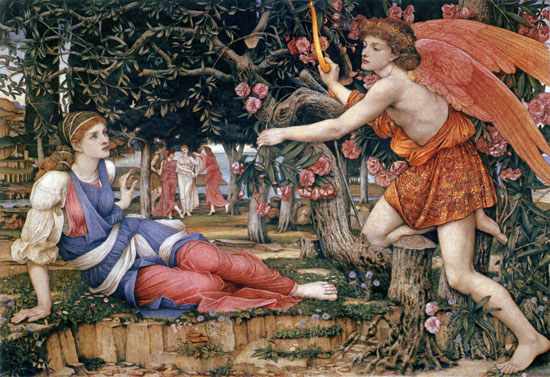 |
| 'Love and The Maiden' (1877) by John Roddam Spencer-Stanhope; Fine Arts Museum, San Francisco |
English painter John Roddam Spencer-Stanhope, born on 20 January 1829 and died on 2 August 1908, is unknown to me and belonged to the second-wave Pre-Raphaelites that also included Evelyn De Morgan. Stanhope was De Morgan's uncle and teacher. He was a friend of Edward Burne-Jones and influenced by him, although Stanhope used stronger colours in his work. He loved the Tuscan landscape and Florentine art and later in life moved to Florence due to health problems. In the painting chosen for today, 'Love and the Maiden', which is considered to be his masterpiece, he pays tribute to 14th century Florentine art. By this date he already lived in Italy permanently. He had access to famous paintings by Italian masters. This painting is based on the Annunciation and the angel Gabriel has been substituted by the winged Eros. The maiden in Stanhope's painting is very similar to the female figure in Botticelli's Venus and Mars. 'Love and The Maiden' was bought at Christie's in 1997 for the sum of 727,500 British Pounds by an Australian art collector. In 2003 he sold it at a profit to the Trustees of the Fine Arts Museum of San Francisco (for the California Palace of the Legion of Honor which is part of the museum). As you might know, I love Pre-Raphaelite art and I am glad to get to know another painter belonging to the group.
Wednesday, 1 August 2012
Jan van Scorel and Maria Magdalene
 |
| 'Maria Magdalene' (c. 1530) by Jan van Scorel; Rijksmuseum, Amsterdam |
Today there was not a whole lot to choose from that was to my liking. But then I stumbled upon Dutch painter Jan van Scorel, born on August 1, 1495 (see his Dutch Wikipedia page for the date). I know this painter by name but never knew exactly what kind of paintings he had made. Nor did I know that he was responsible for introducing Italian High Renaissance art to The Netherlands. He was one of the first Dutch painters to visit Italy and got acquainted with the work of Michelangelo and Raphael. He painted mostly portraits or works with a religious theme. Today's painting 'Maria Magdalene' is actually not oil on canvas but was painted on a panel, like most paintings in the 15th and 16th centuries. In the late 16th century artists started to work more on canvas. Because panels were made of wood, and wood tends to warp over time as a result of changes in temperature and humidity, a top plank had been added to the panel after Van Scorel's time (just above the head of Maria Magdalene). The addition of the extra plank and thus extra blue sky reduced the tension and power of the composition and made the image of Maria Magdalene less strong. Click here for the original (smaller) painting. The size of the original was also more in line with Van Scorel's other paintings which were broader in size. This painting belongs to the collection of the Rijksmuseum, Amsterdam, but Wikipedia names the Frans Hals Museum in Haarlem as current location. Since the Rijksmuseum is still being renovated and won't open until next year, the painting had been on loan to the Frans Hals Museum. I couldn't find on the internet whether it is still on display in Haarlem.
Subscribe to:
Posts (Atom)