Thursday, 31 May 2012

John White Alexander and The Green Dress

'The Green Dress' (c.1890-99) by John White Alexander; Private Collection

Choosing American painter John White Alexander, born on 7 October 1856 and died on 31 May 1915, for today's post was a very quick decision. Just one glance at the images of his paintings made me decide not to look any further. But then I spent an awful lot of time trying to come up with the best painting for this post. Even though I have picked this one, I'm still not sure because there are so many that I love. So just click here and here and here and here, for example. Well, you probably know by now what I like and these are all beautiful paintings of elegant women in stylish dresses. When seeing these paintings, you wouldn't have thought that Alexander had started his career as a political cartoonist and illustrator for Harper's Weekly. He got his formal art training in Europe. When he got back to New York, he became a highly succesful society portrait painter. I think the painting of today is beautiful. Absolutely love the silky fabric of the dress. Alexander has painted more women in green dresses so go and have a look on the internet if you like this one. 

Wednesday, 30 May 2012

Vanessa Bell and Angelica Garnett (née Bell) as Mistress Millament in "The Way of the World"

'Angelica Garnett (née Bell) as Mistress Millament in "The Way of the World" '
(no date found); Government Art Collection

Honestly, I had never heard of painter and interior designer Vanessa Bell, born on 30 May 1879, but I read that she was the sister of Virginia Woolf so I thought it would be interesting to choose her for this post. I had a quick look at the images of her paintings and decided that I like them. Vanessa Bell was born into a well to do family and was educated by her parents at home. Like her sister Virginia, she was encouraged to develop her individual talent. She took drawing lessons and got admitted to the Royal Academy Schools where one of her tutors was John Singer Sargent. After her parents died, she moved with Virginia and their two brothers to Bloomsbury. Here they could entertain their own friends and started the Bloomsbury Group, a group of writers, artists and intellectuals. The portrait I chose is of Angelica Garnett, the daughter of Vanessa Bell and Duncan Grant. I love the colours in this painting! Grant was a member of the Bloomsbury Group and a homosexual. Bell had an affair with him and subsequently a child. They pretended that Angela was Clive Bell's child, Vanessa's husband. They got away with the deceit until Angela was 19 years old. It sounds like a soap opera to me but there's more. Angela married David Garnett who was a former lover of her biological father Duncan, a fact that she was unaware of for some time. With so much drama, there's got to be a memoir and there is. It's titled 'Deceived with kindness' by Angela Garnett. 

Tuesday, 29 May 2012

George Washington Thomas Lambert and Miss Helen Beauclerk

'Miss Helen Beauclerk' (1914) by George Washington Thomas Lambert;
Art Gallery of New South Wales, Sydney

I had never heard of the Australian painter George Washington Lambert, born on 13 September 1873 and died on 29 May 1930. In fact, I don't know Australian art at all. Lambert was a portrait painter and became a war artist during the First World War. When I googled the images of his paintings, it was the painting of Miss Helen Beauclerk that stood out for me. Helen de Vere Beauclerk (1892-1969) was a British writer. Lambert captured her face beautifully and emphasized the hands, something that he started to do with all his sitters. In this particular painting he shows Helen putting on her gloves, while stroking with her bare hand the gloved index finger on the other hand. I think it's a beautiful painting.

Monday, 28 May 2012

Kees van Dongen and The Corn Poppy

'The Corn Poppy' (c.1919) by Kees van Dongen; Museum of Fine Arts, Houston

Today I had a hard time choosing just one painting by Dutch painter Kees van Dongen, born on 26 January 1877 and died on 28 May 1968. Because there are many that I like. Van Dongen was a Fauvist painter and was involved with the German expressionist movement Die Brücke. In his first paintings he used dark tones, influenced by the work of Rembrandt. By the mid-1890s his colour palette changed and he started using brighter colours and his brushstrokes became more animated. In 1897, Van Dongen arrived in Paris where he would share a studio with Picasso. It was here in Paris that he developed into a celebrated artist. He became famous for his numerous colourful portraits of women. Some time ago I visited the wonderful exhibition 'The big eyes of Kees van Dongen' in the Museum Boijmans Van Beuningen in Rotterdam and it was great to see so many paintings together. I cannot remember whether today's painting was on display but I love it. Stunning red hat and black eyes! To cheat once more, I will show you some more paintings. Because I like this one as well, and this one, and this one, and this one. I could go on and on!

Sunday, 27 May 2012

Nicolas Colombel and Venus and Cupid with the Three Graces

'Venus and Cupid with the Three Graces' (date unknown) by Nicolas Colombel;
no location found

Another day of poor choice led me to discover French painter Nicolas Colombel, born in 1644 and died on May 27, 1717. He was influenced by Raphael and above all Nicolas Poussin, whose work he copied. I like mythology in art and this painting is a friendly depiction in soft colours and lines. I don't know if you're familiar with Greek mythology but the Three Graces are the three goddesses of joy, charm and beauty. They were daughters of the god Zeus and the nymph Eurynome, and were named Aglaia (Splendor), Euphrosyne (Mirth) and Thalia (Good Cheer). They presided over pleasurable social events like dances and banquets, and brought joy to both mortals and gods. They were also the special attendants of Aphrodite (Venus in Latin) and Eros (Cupid), the divinities of love. I couldn't find what is going on in this painting but it looks like they're having some kind of meeting.

Saturday, 26 May 2012

Constance Mayer and The Dream of Happiness


'The Dream of Happiness' (1819) by Constance Mayer; Musée du Louvre, Paris

Today I was struggling to find something to my liking and then stumbled upon French painter Constance Mayer, who was born in 1775 and died on 26 May 1821. Her name is linked to the name of Pierre-Paul Prud'hon, whose pupil she became and with whom she became romantically involved. He was married but his wife was declared insane and committed to an asylum. I just found a recent post on their tragic affair on another blog so if you're interested, please click here. Today's painting of 'The Dream of Happiness' has a romantic mood, which was popular in the early 19th century. I think it's beautiful in colour and lighting. It's painted in a more abstract style, something Mayer started to do after having used the same style as Prud'hon for many years. The painting shows a married couple and their child drifting in a boat down the River of Life. Mayer dreamt of having a family of her own but never had one. When Prud'hon's wife died, he promised her on her deathbed never to remarry. In despair Mayer slit her throat with Prud'hon's razor. Overcome by grief, he sank into a depression and died only two years later. They were buried in the same tomb in Paris. For further reading, click here. I will give you the Wikipedia page on Mayer in German because it's not available in English.

Friday, 25 May 2012

Carlo Dolci and The Angel of Annunciation

'The Angel of Annunciation' (1653-55) by Carlo Dolci; Musée du Louvre, Paris

It didn't take me long to select this painting by Italian artist Carlo Dolci, born on 25 May 1616, for today because I think it's a lovely portrait with very beautiful colours. I love the red hair and the deep blue in the clothing. Dolci was the leading painter in mid-17th century Florence and skilled in portrait painting. His work is characterised by intense religiosity and sophisticated style. By the 1640s, Dolci had gained much popularity and his work was in such demand that he often repeated his compositions. After the late 1640s, his troubled personality became more evident in his work. I want to show you two more examples of his portraits that I find really beautiful. Please click here and here

Thursday, 24 May 2012

Samuel Palmer and The Shearers

'The Shearers' (1833-34) by Samuel Palmer; Private Collection

I had never heard of British visionary landscape painter Samuel Palmer, born on 27 January 1805 and died on 24 May 1881, until today. He was a key figure of English Romantic landscape painting and a pupil and friend of William Blake. He treated his landscapes as visions of paradise (click here to see more of his paintings). After 1835, this visionary quality disappeared and his later paintings were done in a more conventional pastoral mode. Today's painting 'The Shearers' had been in the news in 2009 when the Culture Minister issued an export ban on the painting in a last attempt to raise money to keep the painting in the UK. According to the Reviewing Committee on the Export of Works of Art and Objects of Cultural Interest, 'The Shearers' was so closely connected with the history of the UK that it would be considered a great loss if the painting would leave the country. The recommended price for purchase was 3,800,000 pound sterling. Eventually the painting came into possession of private London art dealer and adviser Richard Nathanson. I think the painting is beautiful and everybody can see that the yellow colour and the light is stunning. For further reading on the painting, click here.

Wednesday, 23 May 2012

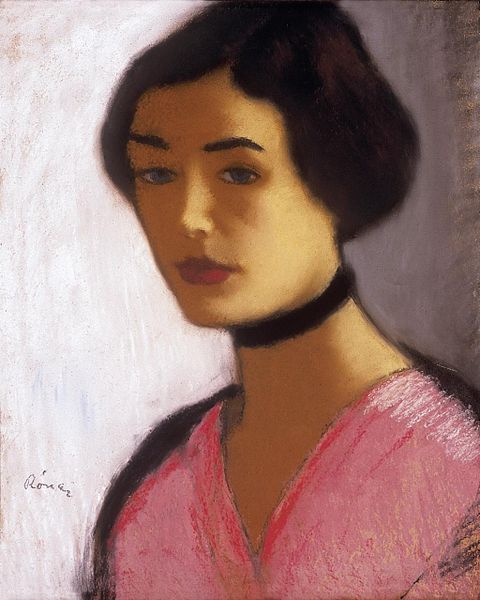
József Rippl-Rónai and Woman in Pink Dress and Black Collar

'Woman in Pink Dress and Black Collar' (1915) by József Rippl-Rónai;
Private Collection

I had never heard of Hungarian painter József Rippl-Rónai, born on May 23, 1861. But I am glad to do a post on him today because there's a lot of his work that I liked instantly. In 1884 he studied art at the Academy in Munich and in 1887 he went to Paris to work in the studio of Mihály Munkácsy. Two years later he distanced himself from the style of Munkácsy and became friendly with Scottish artist James Pitcairn-Knowles. Together they moved to Neuilly near Paris. Between 1889 and 1900, his style was characterised by the reduction of colours. The painting shown here is of a later date when he used bright colours again. I love this portrait and the soft pink. It is pastel on paper and not oil on canvas which is not so difficult to see.

Tuesday, 22 May 2012

Mary Cassatt and Young Woman Reading

'Young woman reading' (1876) by Mary Cassatt; The Museum of Fine Arts, Boston

It's incredible how many paintings exist depicting women reading. Here is another one by Mary Cassatt, born on 22 May 1844. She was an American Impressionist painter who was specialised in painting children. I never liked her paintings very much but I guess I didn't really like the paintings of children. Seeing all the images of her paintings together, there is enough left for me to like. Cassatt became one of the leading American painters at a time that the art world was predominantly male. She studied art both in the States and Europe. In 1871, she spent eight months in Parma, Italy, doing an extensive study on the Italian painter Correggio. I read that the result can be seen in her work, notably in her paintings of children. Apparently they owed much to Correggio's paintings of Madonna and child. I have to tell you that if I wouldn't have known this, I would never have guessed. But still, it makes you look at her paintings of children in a different way. Correggio was not the only painter who had inspired Cassatt. She met Edgar Degas in 1877 and he became the greatest influence on her artistic career. They had a stormy and productive relationship that lasted 40 years but they weren't romantically involved. Although there had been speculations. It was Degas who suggested she'd join the Impressionist exhibition of 1877. By 1880, Cassatt was an acknowledged member of the Impressionist group and exhibited regularly in their shows, the only American painter who succeeded in doing this. Today's painting is one of her many depictions of a woman reading. I love the image and the colours!