Sunday, 30 September 2012

Lucien Lévy-Dhurmer and Portrait of Mademoiselle Carlier or, The Lady in the Turban

'Portrait of Mademoiselle Carlier or, The Lady in the Turban' (1910) by Lucien Lévy-Dhurmer; Musée d'Orsay, Paris

I absolutely love the painting I have chosen for today. The name of French painter, Lucien Lévy-Dhurmer, born on 30 September 1865, rang a distant bell but I did not really know his work. He was a master of pastels and was one of the most important French Symbolist/Art Nouveau artists, having started his career as a ceramist with frequent exhibitions in Paris. In 1895 he started a career in painting and after a visit to Italy, he got acquainted with Renaissance art. In 1896 he exhibited for the first time at the Galerie Georges Petit with about twenty pastels and paintings. In the early 20th century he departed gradually from Symbolism and dedicated himself more to landscape painting as a result of his travels in Europe and North-Africa. Today's painting is a pastel on paper, pastels being Lévy-Dhurmer's favourite medium. It has a dreamlike quality. I love the colours and the hazy depiction of the woman, like she's wrapped in mystery. The female form became one of the painter's favourite themes, influenced by the art of the Pre-Raphaelites. I think this is so beautiful.

Saturday, 29 September 2012

'Esther before Ahasuerus' by Tintoretto

'Esther before Ahasuerus' (1547-48) by Tintoretto; Royal Collection, Windsor Castle

When you say Tintoretto, the great Italian painter who was born as Jacopo Comin on September 29, 1518, only his dark portraits come to mind and I feel like an art illiterate that I can't really tell you what his great paintings are or what he is known for. Tintoretto was one of the most important painters of the Italian Late Renaissance. His nickname 'Il Tintoretto' means 'the little dyer' and derives from his father's profession of dyer. He is usually described as a Mannerist painter and initally being inspired by the work of Michelangelo, he became increasingly concerned with the maximum use of chiaroscuro. He is said to have briefly studied with Titian but a mutual dislike caused an animosity between them that lasted throughout their careers. Unlike Titian, Tintoretto spent almost all of his life in Venice where his work is still to be seen in churches or other buildings. After Titian's death in 1576, he was one of the leading artists of Venice, together with Paolo Veronese. He was most productive between 1564 and his death in 1594. His most famous works are the pictorial decorations he made for the rooms of La Scuola Grande di San Rocco in Venice (click here to see one of the paintings on the ceiling, and to see more, click here). Also the four paintings he did for the Scuola Grande di San Marco (his St. Mark paintings) are considered to be masterpieces, click here. The painting I chose for today is a religious one of 'Esther before Ahasuerus', painted at a time that Tintoretto's career was about to take off. The artwork illustrates the Old Testament story of the Jewish heroine Esther who appears, unbidden, before the King Ahasuerus and pleads for her people, breaking court etiquette and risking her life. She had fasted for three days to prepare herself and faints in his presence. She gets her wish granted. I like this painting because of the story and the beautiful depiction and colours. And I love doing this blog because now I know more about the great Tintoretto and will never forget what he is known for.

Friday, 28 September 2012

Alexandre Cabanel and Albaydé

'Albaydé' (1848) by Alexandre Cabanel; Musée Fabre, Montpellier

The choice for French painter Alexandre Cabanel, born on 28 September 1823, was quickly made but to select one painting for today took a bit longer. There are many paintings that I like. I have to tell you that I had never heard of Cabanel but he was apparently a major artist. He painted portraits and historical subjects in the academic tradition and was together with William Adolphe Bouguereau one of the most succesful and influential academic painters of his time. He studied at the École des Beaux-Arts in Paris and made his debut at the Paris Salon in 1844. He won the Prix de Rome scholarship the following year which enabled him to go to Rome. His painting The Birth of Venus (1863) is one of the most well-known 19th century paintings and his best-known work. It was exhibited at the Salon in 1863 and bought by Napoleon III for his private collection. Cabanel was an opponent of Impressionism and as a member of the Paris Salon, he didn't allow Édouard Manet and many other painters to exhibit their work at the Salon in 1863. This led to the establishment of the Salon des Refusés. Today's painting is the last in a series of three paintings that Cabanel made for his chief patron Alfred Bruyas. 'Albaydé' was inspired by Victor Hugo's poem 'Fragments of a Serpent'. I think it's a beautuful painting and I cannot really tell you why I chose this one over his other paintings other than that the woman's face is captivating. I found a very long article on Cabanel so if you are interested in his life and work, then you should definitely click here.

Thursday, 27 September 2012

Edward Okun and The War and Us

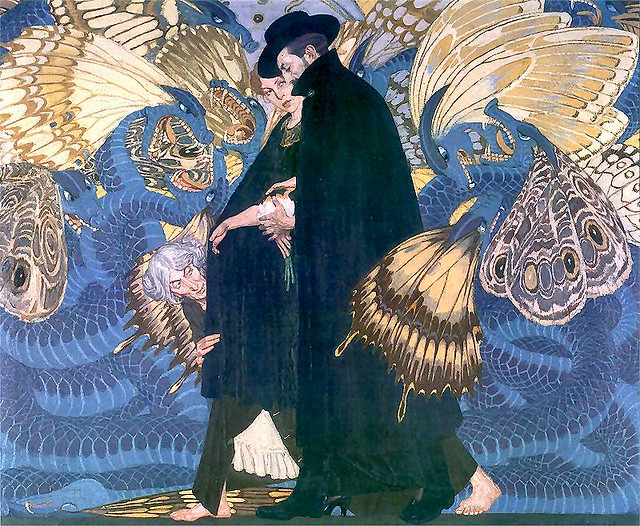
'The War and Us' (1917-23) by Edward Okun; National Museum, Warsaw

Maybe I wouldn't have chosen Polish Symbolist painter Edward Okun, born on 27 September 1872, if I had more to choose from. But I really like today's painting. I tried to find more information on this painting and its symbolic meaning but I was unsuccesful. Even the information on Okun is limited (the English Wikipedia page doesn't really have content). He studied in Warsaw, Munich and Paris and lived in Rome for a long time. He had exhibitions in Poland, Paris, Berlin and Munich. I like this painting and its composition, the vibrant blue colour and rich decorations. I wish I knew what it meant and what the old woman is doing, lurking behind the couple.

Wednesday, 26 September 2012

Arthur Bowen Davies and Juno and The Three Graces

'Juno and The Three Graces' (1902) by Arthur Bowen Davies; Hunter Museum Of American Art, Chattanooga

The choice was a bit meagre today but I'm happy to choose Arthur Bowen Davies, born on 26 September 1863, an American painter unknown to me. Davies studied art in Chicago and moved to New York to study at the Art Students League. He was a member of The Eight, a realist artistic movement of eight American artists who had one show together in 1908 that created a sensation. Davies was influenced by the painters of the Hudson River School and in particular by the dreamlike landscapes of George Innes, a painter whom I got to know while doing this blog and whose work I really like. I think the painting I chose for today has that same dreamlike quality that Innes displays in his work. The subject here is mythological. We see Juno, wife of Jupiter, with The Three Graces in the background. The Three Graces were attendants of Juno (among others) and were usually depicted as nude women dancing in a circle while holding hands (click here if you want to read more). I love the green and the splash of yellow!

Tuesday, 25 September 2012

Arthur Hacker and Lost Parasol

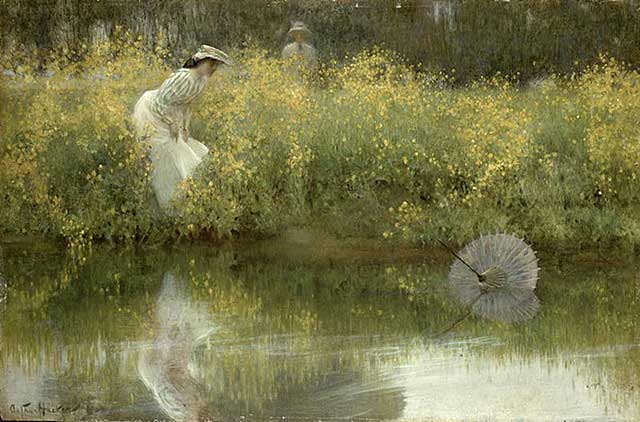
'Lost Parasol' (1902) by Arthur Hacker; Private Collection

I so love doing this blog! I had never heard of Pre-Raphaelite painter Arthur Hacker, born on 25 September 1858. I just discovered him and am happy to use him for this post. Hacker studied at the Royal Academy schools before going to Paris. There he studied under French painter Léon Bonnat who was well-known for his portraits and a friend of Edgar Degas. Hacker became a painter of portraits and historical and religious scenes. He also painted mythological and allegorical subjects. The Wikipedia page (click on author's name) mentions that Hacker is a Classicist painter but doesn't say anything about him being part of the Pre-Raphaelite circle. I think some of his paintings are very much in the Pre-Raphaelite style like The Temptation of Sir Percival or The Drone, and I found many mentions of him being a Pre-Raphaelite painter (click here for a list of Pre-Raphaelite painters). I chose today's painting because apart from portraits, I also like narrative paintings a lot. Looking at this lighthearted scene, it makes you wonder whether the woman will be able to retrieve the parasol without getting her feet wet and why the man in the background isn't helping her.

Monday, 24 September 2012

Robert Lefèvre and Woman With A Lyre

'Woman With A Lyre' (1808) by Robert Lefèvre; Private Collection?

Sometimes it's not so bad when there's not much to choose from. I found this painting by French painter Robert Lefèvre, born on 24 September 1755, very quickly. Lefèvre worked as a law clerk before turning to painting. He established a reputation quite quickly and made a name with religious and history paintings. He was influenced by Jacques-Louis David, which is evident, and his work was also being compared to David's. Under Napoleon's reign, he became a portrait painter of the Emperor and his family. I really like today's painting and the depiction of the white blouse, the fabric, and the detail of the button on the sleeve. I didn't find the painting's location but in 2008, it had been put up for auction at Christie's, see details here (listed as Portrait of a Lady).

Sunday, 23 September 2012

William Clarke Wontner and Portrait Of A Beauty

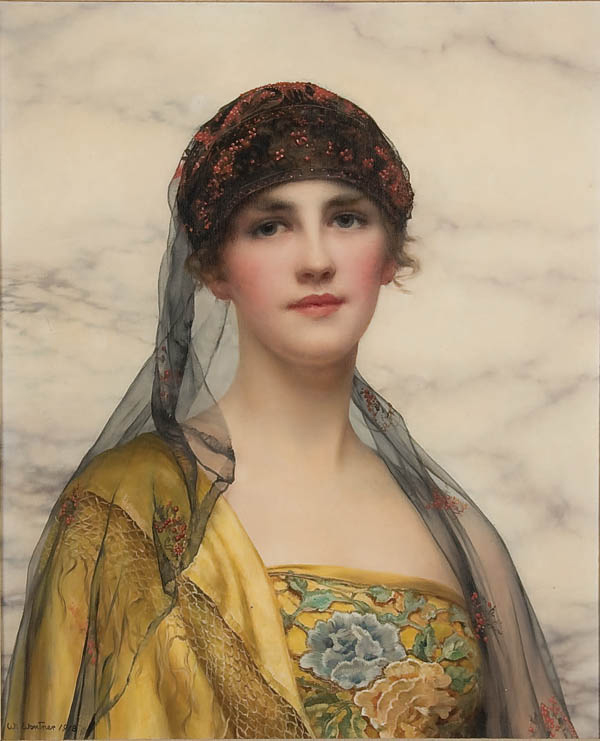
'Portrait Of A Beauty' (1918) by William Clarke Wontner; Private Collection?

For today I had already drafted this painting by English portrait painter William Clarke Wontner, born on 17 January 1857 and died on 23 September 1930, so no time spent on searching for today's match. Wontner was part of the Neoclassical movement of which Lawrence Alma-Tadema was the foremost leader. I wasn't familiar with Wontner, but I had come across the work of English painter John William Godward while doing this blog. When I saw the images of the paintings by Wontner, they immediately brought back to mind the work of Godward. So it was nice to find out that Wonter worked with Godward while being under the tutelage of his father, and they became lifelong friends. They both worked in a style that became known as the Greco-Roman style. Depictions of beautiful seductive women against oriental marbled backdrops. When you see Wontner's paintings together, you can imagine it's a bit difficult to choose one painting, or simply choose one that stands out because they all look a bit similar. So I cannot really tell you why I singled out this painting because I could also have chosen this one or this one or this one. I just like the colours in this painting very much, the woman's face is beautiful and the scarf is exquisite. I couldn't find its location but found that it had been put up for auction at one point so it might be in private hands.

Saturday, 22 September 2012

Herbert James Draper and The Gates of Dawn (detail)

'The Gates of Dawn' (1900) by Herbert James Draper; The Drapers' Company, London


Today's painting is a detail of a painting by English Classicist painter Herbert James Draper, born in 1863 and died on 22 September 1920. The painting is called 'The Gates of Dawn', click here for the full painting. It's not that I don't like the painting in full, nor do I have anything against nudity, but I think the face of the woman is beautiful and you just don't see that when the painting is shown in full (because it simply makes the face smaller and you get distracted by decor and breasts). Draper was a painter of historical subjects and mythological themes from ancient Greece. Today's painting is a portrait of Aurora, the Goddess of Dawn in Roman mythology (in Greek mythology she's called Eos). She is alluring, sexual and powerful. The discarded roses on the floor (only to be seen when you click on the full painting) refer to her insatiable passion. The story goes that one of her mortal lovers, Tithonus, was granted immortality by Jupiter but not eternal youth. When Tithonus grew old, Aurora turned him into a grasshopper. I think Draper captured the 'don't mess with me' look very well. What do you think? Draper was a very succesful painter in his days but is now largely forgotten and seldom seen in auction rooms.

Friday, 21 September 2012

Auguste Toulmouche and The Kiss

'The Kiss' (1886) by Auguste Toulmouche; no location found

When I saw the name of French painter Auguste Toulmouche, born on September 21, 1829, as an option for today, I didn't have to look any further. Doing this blog and browsing through art books and the net, I had come across this painter already numerous times but forgot to look up his dates. So the decision on today's painter was instant but it took me a bit longer to select a painting. Putting his paintings together, you see women in beautiful dresses set in beautiful interiors. Very Alfred Stevens-like. I decided not to choose one of his women portraits. I like them a lot, although they are very sweet and smooth, painted in the French Academic style. I chose a depiction of a man and woman in a private moment. The scene is set in a lush decor and they are both wearing costumes. Maybe they are at a costume ball and slipped away, not being able to restrain their passion any longer. I couldn't find information on this painting other than a subjective article on a personal blog. Click here for an interesting blogpost on Toulmouche's The Reluctant Bride and The Kiss. The blogger describes both paintings as the grit in the licked surface of Toulmouche's paintings. It's not surprising when seeing his paintings (click here and here and here and here, to select a few) that Toulmouche was specialised in costume painting. The phenomenon of costume painting came into view at the height of his career, at a time that people reveled in depictions of sentimental, romantic life. Today's painting is also very romantic and sweet but because it tells the story of stealing a secret kiss (something we can all relate to), it somehow holds more appeal than his women portraits.