Showing posts with label Impressionism. Show all posts

Monday, 31 December 2012

Federico Zandomeneghi and Woman in Corset

'Woman in Corset' by Federico Zandomeneghi

Federico Zandomeneghi, born on 2 June 1841 and died on 31 December 1917

I will continue to post a painting a day for the month of December but I won't have time to write. I may add text at a later date. I hope you will still visit to see the daily painting.

Thursday, 27 December 2012

Robert Vonnoh and The Ring

Robert Vonnoh, born on 17 September 1858 and died on 27 December 1933

Wednesday, 28 November 2012

Frédéric Bazille and The Pink Dress


Frédéric Bazille, born on 6 December 1841 and died on 28 November 1870

During the NaNoWriMo Project, I will continue to post a painting a day for the month of November but I won't have time to write. I may add text at a later date. I hope you will still visit to see the daily painting. 

Wednesday, 14 November 2012

Claude Monet and Portrait of Madame Gaudibert

Claude Monet, born on 14 November 1840

Due to the NaNoWriMo Project, I will continue to post a painting a day for the month of November but I won't have time to write. I may add text at a later date. I hope you will still visit to see the daily painting. 

Tuesday, 13 November 2012

Camille Pissarro and Young Woman Bathing Her Feet


Camille Pissarro, born on 10 July 1830 and died on 13 November 1903

Due to the NaNoWriMo Project, I will continue to post a painting a day for the month of November but I won't have time to write. I may add text at a later date. I hope you will still visit to see the daily painting. 

Thursday, 25 October 2012

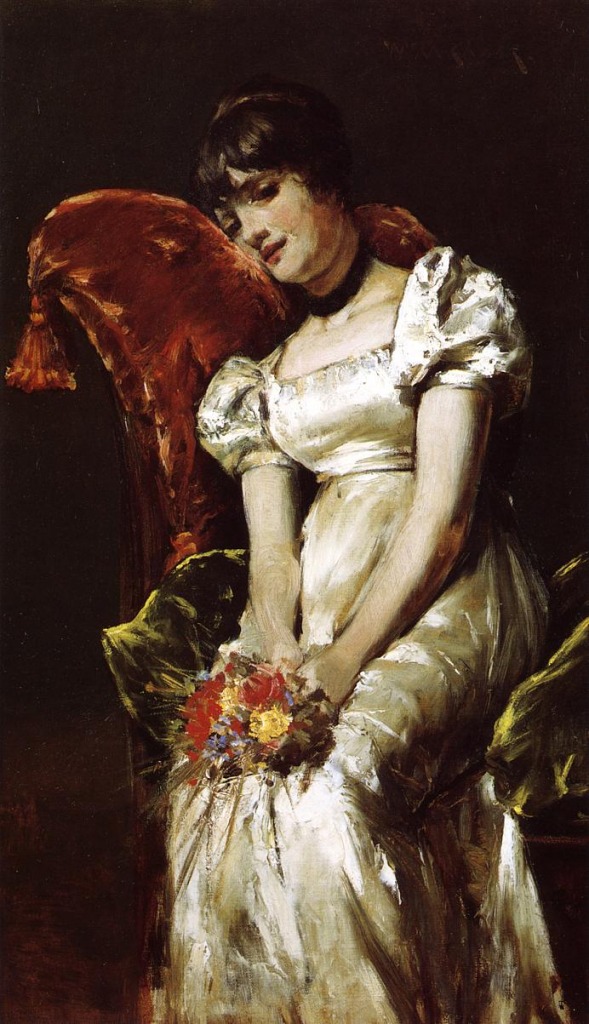
William Merritt Chase and Young Girl with Flowers

'Young Girl with Flowers' (1885) by William Merritt Chase; Palacio Real, Madrid

When you google the paintings of American Impressionist artist William Merritt Chase, born on 1 November 1849 and died on 25 October 1916, you see still lifes, women portraits, women set in landscapes and lush interiors, some paintings of men and children. It is his portraits that he is best known for. I didn't know him before doing this blog, but I have come across his name and paintings so often now that it only feels natural to dedicate a post to him, also because I like his work. He studied art in New York, but it was at the Royal Academy of Fine Arts in Munich where he received his most decisive training. When he returned to New York, he began teaching. He had adopted the plein air method of painting and often taught his students in outdoor classes. He devoted much of his time and energy to teaching and even opened the Chase School of Art in 1896. Two years later it became the New York School of Art. Chase was the most important art teacher around the turn of the 20th century. Many well-known American artists like Georgia O'Keeffe have studied under Chase. For today I have chosen a beautiful portrait of a young girl with flowers. I love the dark background and the contrasting red and green and multiple colours of the bouquet. There's no particular reason why I have chosen this painting when there are so many other paintings that I like and could have chosen. I will provide you with a link, click here, so you can see his other paintings as well. Enjoy!

Wednesday, 17 October 2012

Frederick Childe Hassam and The Sonata

'The Sonata' (1893) by Frederick Childe Hassam; The Nelson-Atkins Museum of Art, Kansas City

Today's artist is Frederick Childe Hassam, born on 17 October 1859, a painter whose name I vaguely recognise but I never really knew his paintings. Hissam was a leading and influential American Impressionist painter who was very productive with over 3,000 artworks over the course of his career. He was initially trained as an apprentice to a wood-engraver and went to art school in Boston and Paris. He spent five years in France where he was influenced by Claude Monet. In 1898, he became one of the founders of The Ten, a group of ten American painters who were considered exponents of Impressionism and who rebelled against the conservative Academy. He painted city life as well as life in the countryside, with great use of colour and light. His most famous paintings are the so-called 'Flag' series, paintings of urban celebrations at the end of World War I. His credo, which he stated in 1892, was: "The man who will go down to posterity is the man who paints his own time and the scenes of everyday life around him." For today I chose a lovely depiction of a woman behind the piano. I just found an article on a blog about the artwork. Apparently it was an important painting to the artist himself. We see a woman who is exhausted after having played Beethoven's difficult and lenghty Sonata Appassionata. This painting was probably the model for his many other interior paintings depicting women. Hassam was very attached to it and after already having sold practically all of his collection, he couldn't let go of The Sonata until 26 years after he painted it.

Sunday, 7 October 2012

Isaac Israëls and Reading Girl On A Sofa

'Reading Girl On A Sofa' (1920) by Isaac Israëls; no location found

It's always nice to be able to do a post on a Dutch painter (because I'm Dutch) and I am happy to introduce you today to Isaac Israëls, born on 3 February 1865 and died on 7 October 1934. He was linked to Amsterdam Impressionism, an art movement of the late 19th century, mainly associated with the great Dutch painter George Hendrik Breitner. Israëls was the son of the painter Jozef Israëls, who was one of the most famous artists of the Hague School, and studied at the Royal Academy of Art in The Hague where he met Breitner. They became lifelong friends. Israëls's passions were painting, travel and literature, and he painted portraits, city views, and women. He often spent his summer holidays at the Dutch seaside resort of Scheveningen with his father and they would invite guests like Édouard Manet and Max Liebermann. Born in Amsterdam and died in The Hague, his work has an Amsterdam period as well as a The Hague one. There were major exhibitions in Amsterdam and The Hague over the summer months and I regret having missed them. I just haven't been paying close attention to what was going on artwise in the last few months (other than the Impressionist exhibition at the Hermitage, Amsterdam, which I háve visited, and will visit again in the coming month because it is wonderful). Anyway, these are the exhibitions that I've missed: one at the Stadsarchief in Amsterdam about Israëls's work in Amsterdam, and one at several museums in The Hague about his The Hague period. I don't even want to look closely at the links I've just provided you with, because I can kick myself for having missed the exhibitions. 

Thursday, 4 October 2012

John Joseph Enneking and Fall Landscape

'Fall Landscape' (1913) by John Joseph Enneking; Private Collection?

For today I found American Impressionist painter John Joseph Enneking, born on 4 October 1841, and I'm happy about the discovery. It is nice to get to know more landscape painters and I really like Enneking's paintings. Especially since the season has recently changed, seeing his fall paintings (sitting on my couch with my little netbook in my lap) makes me somehow feel connected with the weather outside. I like the colours in today's painting, and the desolateness. Enneking got his first art lessons in Cincinnati and Boston. He earned his livelihood in business before committing fully to art. He spent some years in Europe, first in Munich and then studying art in Paris under Daubigny and Léon Bonnat. He also spent some time in The Netherlands. Coming back to the States, he established himself as a landscape painter, working en plein air. Occasionally he painted genre subjects. I couldn't find a date for today's painting, nor its location but found that at some point it was for sale at the Questroyal Fine Art Gallery in New York.

Edit on 14.09.2025: The image link of this post's painting ended up broken so I had to replace the image. I only found one painting with the exact title 'Fall Landscape' on a couple of different websites. But that painting is dated 1913 whereas beneath the missing image of my original listing the caption read 'no date found'. I have no idea of this is the painting of my original post because there are other Autumn Landscape paintings but I'm going to use it anyway. I can imagine it is this particular painting because the colours are so vibrant and I love it!

Sunday, 2 September 2012

Arthur Ernest Streeton and Autumn

'Autumn' (1889) by Arthur Ernest Streeton; Art Gallery of Ballarat, Ballarat, Australia

I had an extremely difficult time finding a painting for today. I decided to use Australian landscape painter Arthur Streeton, even though the Wikipedia page says that his date of death is 1 September 1943. I usually rely on Wikipedia but Safran-Arts mentions September 2, 1943, and that is good enough for me. Otherwise I might have ended up with a painting by an artist that I didn't like at all. In any case, I like this painting and the brightness of the colours. The Wikipedia page shows more of Streeton's paintings and I like these too. I had never heard of this painter but he appears to be no minor artist. His paintings are amongst the most collectible of Australian painters. Streeton was one of the founders of the Heidelberg School, an Australian art movement that has been described as Australian Impressionism. By looking at today's painting, you can see why. The painting 'Autumn' was purchased by the Art Gallery of Ballarat in 1948, and prior to its acquisition, the canvas was cut into two smaller scenes. Eventually they decided against making two paintings out of one. I have no idea why they were even contemplating making two paintings out of one. It must have something to do with size. Anyway, this is one of Streeton's early works and it is one of the few paintings in which he depicts a woman at work. He sometimes named his paintings after works by his favourite poets and this painting is probably named after Keats' ode 'To Autumn'. I like this painting because it is a bit vague in form and there's no uniformity in the depiction of the trees. It gives a sense of a warm day in late summer turning into autumn. Just like the weather here in Amsterdam.

Tuesday, 21 August 2012

Alexander Nikolayevich Samokhvalov and In The Sun

'In the Sun' (1953) by Alexander Nikolayevich Samokhvalov; no location found

Today was one of those days again. I couldn't find a painter that I liked well enough. When I had finally found this Russian painter, Alexander Nikolayevich Samokhvalov, born on 21 August 1894, there weren't that many paintings to choose from. A good thing that I like this one. It's so colourful and the woman seems to be neither happy nor sad. Samokhvalov was probably not such an insignificant painter because Wikipedia has a whole page in English on him. He studied in St. Petersburg and painted mainly portraits and genre paintings. He was one of the painters of the Leningrad School of Painting and their work is well represented in the collections of the major museums throughout Russia. You will recognise today's painting as a work of Impressionism and apparently between 1950 and 1980, artists of the Leningrad School painted in the Impressionist style.

Friday, 10 August 2012

Joaquín Sorolla y Bastida and Under the Awning, Zarauz

'Under the Awning, Zarauz' (1910) by Joaquín Sorolla y Bastida;
St. Louis Art Museum, St. Louis

Joaquín Sorolla, born on 27 February 1863 and died on 10 August 1923, was a Spanish painter from Valencia and specialised in portraits and landscapes. When you google the images of his paintings, you see a lot of seaside scenes and sunlit beaches. Sorollo got his initial education in his native town, at the age of fourteen. When he was eighteen years old, he went to Madrid and studied the paintings of the great masters in Museo del Prado. He received a grant after military service which enabled him to study art in Rome. He went to exhibitions of Jules Bastien-Lepage and Adolf Menzel in Paris and got influenced by their work. Upon his return to Rome he studied with Emilio Sala. He is classified as a Realist and Impressionist painter but anyone can see that his beach paintings are in the Impressionist style. Sorolla's work is represented in museums in Europe and America, and many of his paintings can also be found in private collections. It wasn't difficult for me to choose a painting and I particularly like this one because of the sweet colours and the dresses and hats. I looked up on the internet what Zarauz means and it appears to be a coastal town in Northern Spain.

Sunday, 29 July 2012

Robert Lewis Reid and Tempting Sweets

'Tempting Sweets' (1924) by Robert Lewis Reid; Private Collection

Today's painter, Robert Lewis Reid, born on July 29, 1862, is another American Impressionist painter unknown to me. When I googled the images of his paintings, there were some paintings I liked but there were also a lot of which I thought the colours were too faint. Reid studied at the Boston Museum of Fine Arts School and also went to Paris to study under Gustave Boulanger and Jules Joseph Lefebvre. He painted landscapes, still lifes and murals. When he adopted a more Impressionist style around 1890 and started using a brighter palette, he focussed more on portraying women, often set amidst flowers and gardens. He was one of the founding members of the Ten American Painters, a group of Impressionists who rebelled against traditional art. Towards the end of his life, Reid was partially paralysed by a stroke and had to learn to paint with his left hand. I chose today's painting 'Tempting sweets' because of the colours and I also think the woman is beautiful.

Friday, 20 July 2012

Max Liebermann and The Preserve Makers


Due to my stay and volunteer work in Peru for most of June and July, I won't have time to write but I will continue to post a painting a day. I may add text upon returning to Amsterdam. I hope you will still visit to see the daily painting. 

Wednesday, 11 July 2012

Jean-Louis Forain and Woman At Her Toilette


Due to my stay and volunteer work in Peru for most of June and July, I won't have time to write but I will continue to post a painting a day. I may add text upon returning to Amsterdam. I hope you will still visit to see the daily painting. 

Tuesday, 3 July 2012

Theodore Robinson and Figure in a Landscape


Due to my stay and volunteer work in Peru for most of June and July, I won't have time to write but I will continue to post a painting a day. I may add text upon returning to Amsterdam. I hope you will still visit to see the daily painting. 

Tuesday, 22 May 2012

Mary Cassatt and Young Woman Reading

'Young woman reading' (1876) by Mary Cassatt; The Museum of Fine Arts, Boston

It's incredible how many paintings exist depicting women reading. Here is another one by Mary Cassatt, born on 22 May 1844. She was an American Impressionist painter who was specialised in painting children. I never liked her paintings very much but I guess I didn't really like the paintings of children. Seeing all the images of her paintings together, there is enough left for me to like. Cassatt became one of the leading American painters at a time that the art world was predominantly male. She studied art both in the States and Europe. In 1871, she spent eight months in Parma, Italy, doing an extensive study on the Italian painter Correggio. I read that the result can be seen in her work, notably in her paintings of children. Apparently they owed much to Correggio's paintings of Madonna and child. I have to tell you that if I wouldn't have known this, I would never have guessed. But still, it makes you look at her paintings of children in a different way. Correggio was not the only painter who had inspired Cassatt. She met Edgar Degas in 1877 and he became the greatest influence on her artistic career. They had a stormy and productive relationship that lasted 40 years but they weren't romantically involved. Although there had been speculations. It was Degas who suggested she'd join the Impressionist exhibition of 1877. By 1880, Cassatt was an acknowledged member of the Impressionist group and exhibited regularly in their shows, the only American painter who succeeded in doing this. Today's painting is one of her many depictions of a woman reading. I love the image and the colours!

Sunday, 13 May 2012

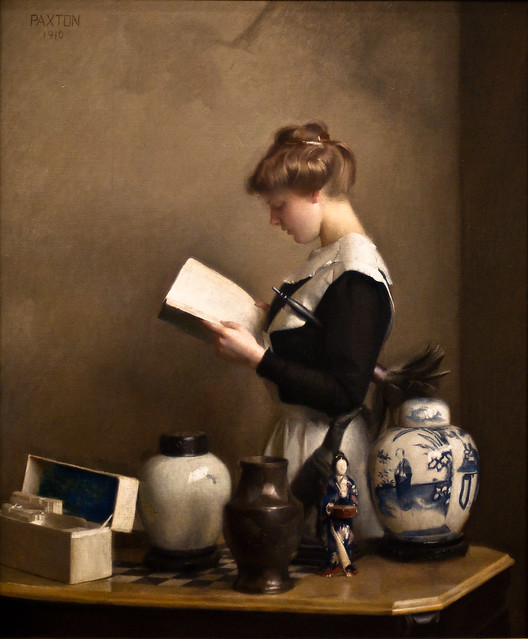
William McGregor Paxton and The House Maid

'The House Maid' (1910) by William McGregor Paxton; Corcoran Gallery of Art, Washington, D.C.

Today is my birthday and I'm happy to share with you this wonderful painting by an artist unknown to me. I found it in an art book and I looked up the dates of birth/death of the artist and guess what? The artist is William McGregor Paxton, born on June 22, 1869, and died on May 13, 1941. Click on the link to the Dutch Wikipedia page because for some reason the English one doesn't give the exact date of death, just the year. Paxton was an American Impressionist painter and let's make it official now: I absolutely love American Impressionist painters! I have come across so many already while doing this blog. I've been wanting to use today's painting ever since I saw it in the art book and fell in love with it. But having seen the images of his other paintings, I simply have to add three more paintings to give you an idea. So please feel free to click here and here and here. Paxton is best known for his portraits and was one of the founding members of The Guild of Boston Artists, together with Edmund C. Tarbell and Frank Weston Benson. The group consisted of Boston painters who all worked in the academic and realist tradition. Paxton painted his women in stylish interiors, like many of his Gilded Age contemporaries. In today's painting the woman depicted is not the mistress of the house though, but the house maid who discovers a book during the course of her duties.  It's not so difficult to see that Paxton was influenced by 17th-century Dutch painter Johannes Vermeer. I love the details and the objects on the table!

Thursday, 26 April 2012

Edmund Charles Tarbell and My Three Granddaughters

'My Three Granddaughters' (1937) by Edmund Charles Tarbell; Private Collection

I have totally rediscovered Impressionism! I honestly thought that I had sort of outgrown my love for (French) Impressionist painters a long time ago but I discover so many new Impressionist painters that I think I might not have gotten tired of Impressionism itself but probably of the famous painters and their famous paintings. I had a small list of painters to choose from today but the moment that I saw the images of the paintings by American Impressionist Edmund Charles Tarbell, born on April 26, 1862, I knew I had found today's match. I'm really glad to have found another amazing painter unknown to me. Then I had the difficult task to choose only one painting for this post. Tarbell was famous for his elegant interiors and paintings of his family. He painted his wife, their four children, his wife's sisters or his grandchildren. The painting 'In the Orchard' (1891) is considered his masterpiece, a depiction of his wife and her siblings. I chose another painting though, an image of his grandchildren and it's called 'My three granddaughters'. I think it is beautiful and I think it's wonderful as well that Tarbell portrayed his family and thus their lives.

Tuesday, 24 April 2012

'In a Dublin Park, Light and Shade' by Walter Frederick Osborne

'In a Dublin Park, light and shade' (c.1895) by Walter Frederick Osborne; National Gallery of Ireland, Dublin

Walter Frederick Osborne, born on 17 June 1859 and died on 24 April 1903, was an Irish Impressionist painter. I thought it would be nice to use him for today's post since I haven't done a post on an Irish painter yet. With Impressionist painters, you immediately think of French painters, since the origin of the art movement lies in France. I like to become acquainted with Impressionist painters beyond France (see the Wikipedia page on the art movement and scroll down to 'Beyond France') and have already done posts on American Impressionists. Osborne was a landscape and portrait painter. In the early 1890s, his work began to show the influence of Impressionism. Brighter colours and an increased interest in shadow and sunlight. He portrayed women, children and elderly people. This painting shown here is one of the few paintings that sold instantly when it was first exhibited at the Royal Academy in 1895. The Impressionist influence of shade and light is evident in this painting but it's not just the visual that Osborne was interested in. The treatment of the figures shows Osborne's empathy with the working class of Dublin. I think it's a beautiful painting. I love the use of shade and light, and my eyes keep being drawn towards the care-worn face of the woman on the bench. I think Osborne captured the look on her face perfectly. For further reading, click here.