Showing posts with label Symbolism. Show all posts

Sunday, 25 November 2012

Maurice Denis and The Muses

Maurice Denis, born on 25 November 1870

Due to the NaNoWriMo Project, I will continue to post a painting a day for the month of November but I won't have time to write. I may add text at a later date. I hope you will still visit to see the daily painting.

Thursday, 18 October 2012

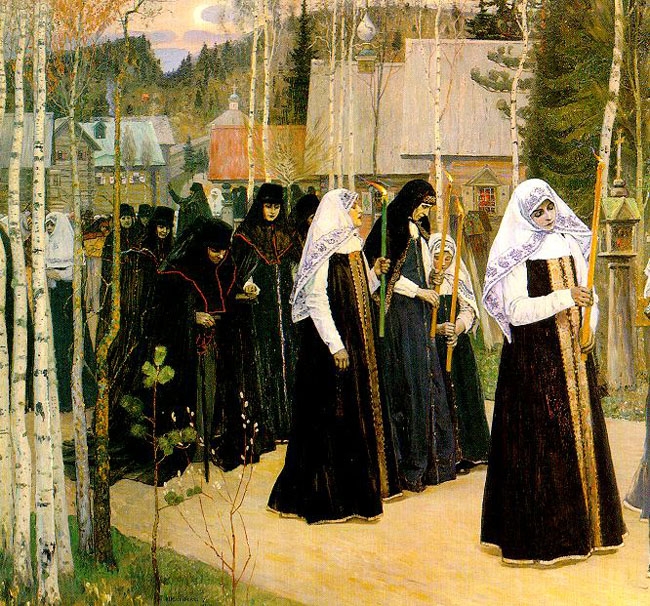
Mikhail Nesterov and Taking the Veil

'Taking the Veil' (1897-98) by Mikhail Nesterov; State Russian Museum, St. Petersburg

I had never heard of Russian painter Mikhail Nesterov, born on 31 May 1862 and died on 18 October 1942, but he was a major representative of religious Symbolism. He was born into a merchant family and received an orthodox education. He studied art in Moscow, and joined a group of artists called Peredvizhniki, The Wanderers. He first tried his hand at historical paintings and everyday life scenes but became increasingly interested in religious themes. He was more influenced by French Symbolism, and in particular by the work of Jules Bastien-Lepage, than by old Russian icon painting. The landscape plays an important role in Nesterov's paintings, and there's a lyrical connection between his figures and their surroundings. I chose today's painting because it has such a Pre-Raphaelite quality. A group of nuns are taking part in a procession to accompany a novice who's about to take the veil, with in the background the Volga countryside. Nesterov was doing a cycle of paintings on the fate of Russian women and was inspired by the writings of Pavel Ivanovich Melnikov. I love this painting more the longer I look at it. Just by watching the solemnn faces, I can almost imagine myself clicking the play button on this image, and the procession will go on and beautiful music is being heard.

Tuesday, 2 October 2012

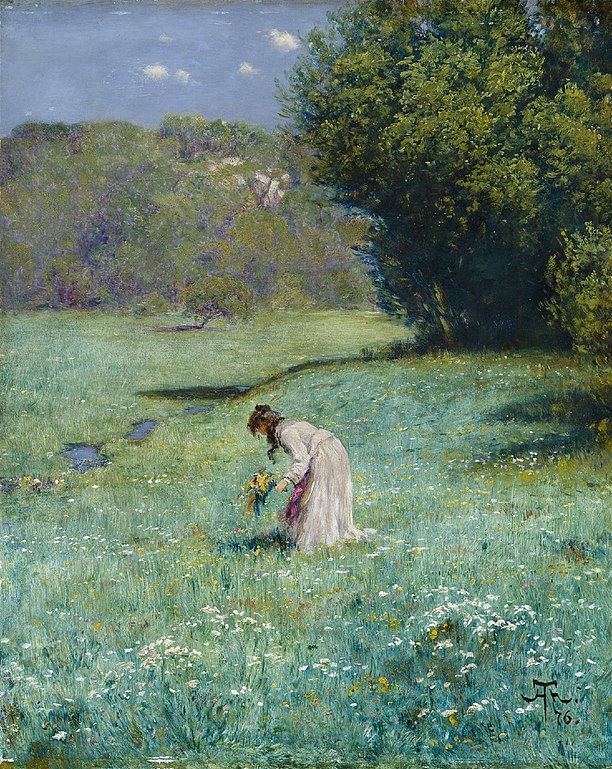
Hans Thoma and Woodland Meadow

'Woodland Meadow' (1876) by Hans Thoma; Hamburger Kunsthalle, Hamburg

There was not so much to choose from today but I am happy to get acquainted with German painter Hans Thoma, born on 2 October 1839. If you click on the Dutch Wikipedia page, you see more images of his paintings and I also like this one very much. Thoma practised various styles but was mainly associated with Symbolism. He studied at the Karlsruhe Academy, went to Paris in 1868 and was influenced by Gustave Courbet and the Barbizon School. His style is difficult to interpret and it's also said that he had affinities with the Pre-Raphaelites. He had attention to detail and loved nature. Today's painting is a lovely depiction of a woman picking flowers. It looks a bit like an Impressionist painting to me. In any case, it makes you long for spring again.

Sunday, 30 September 2012

Lucien Lévy-Dhurmer and Portrait of Mademoiselle Carlier or, The Lady in the Turban

'Portrait of Mademoiselle Carlier or, The Lady in the Turban' (1910) by Lucien Lévy-Dhurmer; Musée d'Orsay, Paris

I absolutely love the painting I have chosen for today. The name of French painter, Lucien Lévy-Dhurmer, born on 30 September 1865, rang a distant bell but I did not really know his work. He was a master of pastels and was one of the most important French Symbolist/Art Nouveau artists, having started his career as a ceramist with frequent exhibitions in Paris. In 1895 he started a career in painting and after a visit to Italy, he got acquainted with Renaissance art. In 1896 he exhibited for the first time at the Galerie Georges Petit with about twenty pastels and paintings. In the early 20th century he departed gradually from Symbolism and dedicated himself more to landscape painting as a result of his travels in Europe and North-Africa. Today's painting is a pastel on paper, pastels being Lévy-Dhurmer's favourite medium. It has a dreamlike quality. I love the colours and the hazy depiction of the woman, like she's wrapped in mystery. The female form became one of the painter's favourite themes, influenced by the art of the Pre-Raphaelites. I think this is so beautiful.

Thursday, 27 September 2012

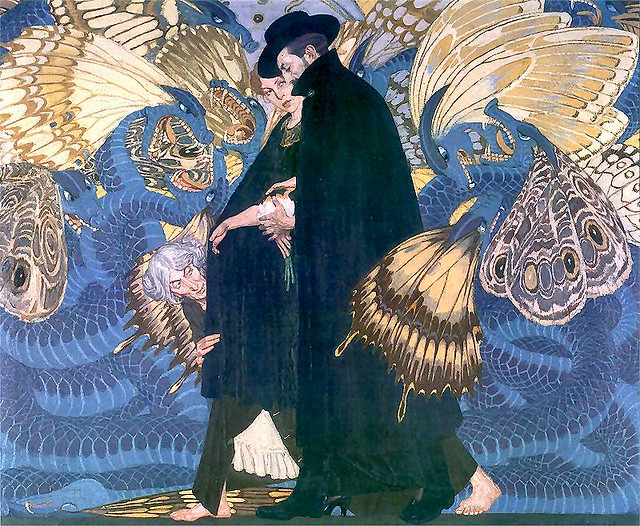
Edward Okun and The War and Us

'The War and Us' (1917-23) by Edward Okun; National Museum, Warsaw

Maybe I wouldn't have chosen Polish Symbolist painter Edward Okun, born on 27 September 1872, if I had more to choose from. But I really like today's painting. I tried to find more information on this painting and its symbolic meaning but I was unsuccesful. Even the information on Okun is limited (the English Wikipedia page doesn't really have content). He studied in Warsaw, Munich and Paris and lived in Rome for a long time. He had exhibitions in Poland, Paris, Berlin and Munich. I like this painting and its composition, the vibrant blue colour and rich decorations. I wish I knew what it meant and what the old woman is doing, lurking behind the couple.

Monday, 17 September 2012

Edgar Maxence and St. Thérèse de Lisieux (detail)

'St. Thérèse de Lisieux' (1931) by Edgar Maxence; no location found

It happens quite often that I struggle to come up with a painting to post one day, and the other day I have problems choosing between two or more painters. On a fortunate day, after having chosen the painter, it can still leave me with some difficulty to choose just one painting. After a couple of days of struggling, today was such a day. I checked out the paintings of the first painter on my list, Edgar Maxence, and immediately liked them a lot. I should have stopped right there but then looked at the paintings of the next painter on my list, Robert Vonnoh, and I liked his paintings as well. To avoid frustration discovering more painters suitable for today, I stopped looking and decided to choose between these two painters. Actually, I felt more like posting a painting by Edgar Maxence because his work is really beautiful. Both painters have their date of birth on the 17th of September. But I couldn't find an exact date of death for Maxence while Vonnoh's is still coming up in December. So I will leave Vonnoh for December and am extremely pleased to introduce you to the art of Edgar Maxence, born on 17 September 1871. He was a French Symbolist painter, a student of Elie Delaunay and Gustave Moreau at the École des Beaux-Arts in Paris, and exhibited regularly at the Paris Salon from 1894. He is a painter of portraits, still lifes and landscapes but perhaps best remembered for his paintings with subjects taken from the bible or ancient legends. His style is influenced by early Italian Renaissance and late Pre-Raphaelite art. He often enriched his work with gold and silver foil. Amongst his best-known paintings are Girl with a Peacock and The Soul of the Forest (which is exquisite!). I struggled with choosing just one painting for today and could have chosen Sérénité or Portrait of a Young Girl or the beautiful The Missal, but I couldn't tear myself away from the painting that I háve chosen. It's a portrait of the Saint Thérèse of Lisieux and I think it's absolutely beautiful. This is a detail, click here for the complete artwork. Unfortunately it's not very large nor clear. Click here for the detail and complete artwork next to each other.

Monday, 10 September 2012

Laurits Andersen Ring and At Breakfast

'At Breakfast' (1898) by Laurits Andersen Ring; Nationalmuseum, Stockholm

Today the choice was easy because as soon as I saw this painting while googling the images of the paintings by Danish artist Laurits Andersen Ring, born on 15 August 1854 and died on 10 September 1933 (see the Danish Wikipedia page for the exact date details), I recognised this image from my calendar of women reading in art. The calendar is no longer in use because it's last year's but I have kept it and this is one of the images that I would like to frame and hang in my kitchen. I had never heard of this Danish artist before but Ring was one of the most important Danish Symbolist painters of the turn of the 20th century. He was also a pioneer in social realism in Denmark. He was born in the village Ring and later on adopted the name of his native village to avoid confusion in names when he held an exhibition with his friend Hans Andersen. Having studied at the Danish Academy of Arts and briefly with painter Peder Severin Krøyer, he had his first exhibition in 1882. This was a period of political turmoil in Denmark and Ring began to care deeply for the poor and their social situation. In 1896 he married the painter Sigrid Kähler who had posed for some of his paintings. He was 42 years old at the time and she only 21. They had three children before Kähler died at the age of 49. I think his marriage must have been a happy one. In today's painting, we see a lovely depiction of the artist's wife while sitting and reading the newspaper at the breakfast table. The whole atmosphere of the painting, with the sunlit garden in the background, breathes an air of calm. Ring had obviously wanted to stage such a peaceful scene as a setting for his wife. We see myrtle branches forming a crown above her head. This tree is a symbol of love according to Greek mythology. In Denmark twigs of myrtle are used to adorn the bride at wedding ceremonies. This painting is clearly an indication of the artist's love for his wife. Like this one, called The Artist's Wife. I'm a romantic at heart and like both paintings very much.

Tuesday, 28 February 2012

William Degouve de Nuncques and Nocturne at the Royal Park

'Nocturne at the Royal Park, Brussels' (1897) by William Degouve de Nuncques; Musée d'Orsay, Paris

Yesterday I visited the new exhibition on Symbolism, Dreams of Nature, at the Van Gogh Museum in Amsterdam. There were beautiful paintings on display, some with incredible lighting, but I cannot post any of them here today, simply because the date of birth/death of the artists don't match. So I searched for a suitable artist and inspired by yesterday's exhibition, decided to post a painting of Belgian painter William Degouve de Nuncques, born on 28 February 1867. I had never heard of him but apparently the wonderful Kröller-Müller Museum in Otterlo, that I have visited a couple of times, has the best collection of his paintings. He was a Symbolist painter and a major influence on Surrealism. His art is magical and mysterious and bears the influence of Symbolist poetry. I love this painting and I can imagine what it must be like seeing this in real life. Entering a room and being completely drawn in by the incredible light. This image from the internet certainly doesn't do the painting justice but it definitely makes you want to see the real thing.

Thursday, 23 February 2012

George Frederic Watts and Dame Alice Ellen Terry ('Choosing')

'Choosing' (1864) by George Frederic Watts; National Portrait Gallery, London

I know this painting, not by name, and I know George Frederic Watts, born on 23 February 1817, vaguely by name, but never made the connection between the two. Watts was an English Pre-Raphaelite and Symbolist painter and sculptor. In the 1850s, he moved in with the family of Valentine Cameron Prinsep and he dedicated himself to portrait painting. His work showed the influence of the Pre-Raphaelites. His gallery of portraits of eminent Victorians is unsurpassed. One of these paintings portrays a young woman, shown here. Her name was Ellen Terry, an actress, and Watts married her when she was sixteen years old and he was thirty years her senior. The date of the painting is actually unknown but it is said that it was probably painted around the time that Watts married Ellen, thus 1864. The marriage lasted only ten months. In his later paintings he turned to Symbolism and he is probably best remembered for these paintings. For me it was hard to choose between 'Choosing' and the Symbolist painting 'Hope' (1886), both different in style but equally beautiful. You can see the latter in the Tate National Gallery in London or here.

Monday, 6 February 2012

Gustav Klimt and The Kiss

'The Kiss' (1907-08) by Gustav Klimt; Österreichische Galerie Belvedere, Vienna

Most people will know Austrian Symbolist painter Gustav Klimt (July 14, 1862 - 6 February, 1918) because of his golden paintings. Probably most famous is 'The Kiss'. I have a reproduction myself. It's hanging in a big golden frame in my kitchen. It's so beautiful that I never get tired of it. The colours are stunning and I think it's magical. Klimt used gold leaf for the paintings from his 'golden phase'. His father was a gold engraver by trade so that could have had something to do with it. 'The Kiss' was already popular in Klimt's time and hasn't lost in beauty till this day.