Showing posts with label Neoclassicism. Show all posts

Sunday, 30 December 2012

François-André Vincent and Arria and Poetus

'Arria and Poetus' by François-André Vincent

François-André Vincent, born on 30 December 1746

I will continue to post a painting a day for the month of December but I won't have time to write. I may add text at a later date. I hope you will still visit to see the daily painting.

Friday, 12 October 2012

François-Joseph Navez and Holy Women

'Holy Women' (c. 1820) by François-Joseph Navez; Musée du Louvre, Paris

Today's choice was quickly made. I had never heard of Belgian Neoclassical painter François-Joseph Navez, born on 16 November 1787 and died on 12 October 1869 (Wikipedia doesn't give the exact dates, but Safran Arts does), but one look at the images of his paintings, I knew I didn't have to search any further. Probably the reason why I like his paintings is because they are very reminiscent of Jacques-Louis David and it turns out that he was David's pupil. After his studies in Paris, he went to Rome where he made the acquaintance of Jean-Auguste Dominique Ingres, that other great Neoclassical painter who had also been a pupil of David. He was a great admirer of Ingres and his work reflected Ingres's combination of Neoclassical and Romantic style. Returning to Belgium, he became the director of the Brussels Academy. His history and genre paintings as well as his portraits display rich colours and a figurative approach typical of Neoclassicism. The painting I have chosen for today is such an example, and as you might see, even more Ingres-like than David-like. I think it is beautiful and also found a site that shows you the restauration of this artwork. But besides this painting, there are many that I like. I think that Massacre of the Innocents (1824) is really beautiful too and should maybe have deserved this post but you can't win them all. 

Sunday, 23 September 2012

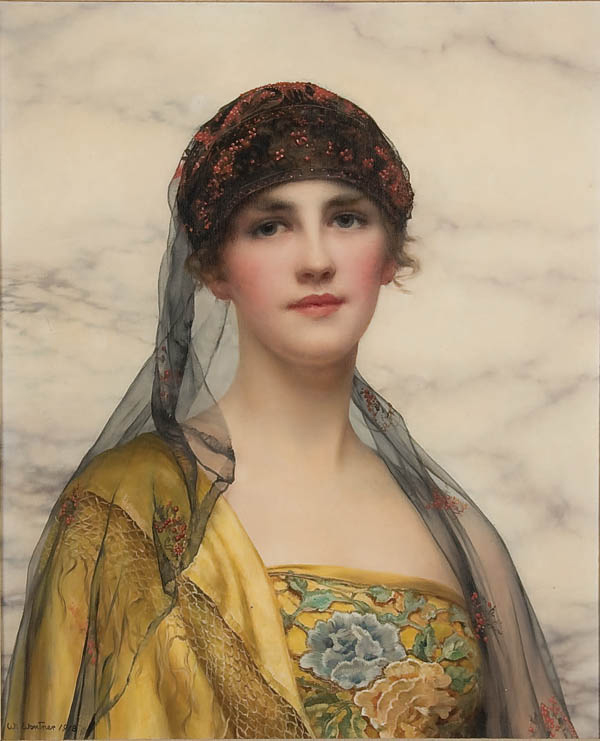
William Clarke Wontner and Portrait Of A Beauty

'Portrait Of A Beauty' (1918) by William Clarke Wontner; Private Collection?

For today I had already drafted this painting by English portrait painter William Clarke Wontner, born on 17 January 1857 and died on 23 September 1930, so no time spent on searching for today's match. Wontner was part of the Neoclassical movement of which Lawrence Alma-Tadema was the foremost leader. I wasn't familiar with Wontner, but I had come across the work of English painter John William Godward while doing this blog. When I saw the images of the paintings by Wontner, they immediately brought back to mind the work of Godward. So it was nice to find out that Wonter worked with Godward while being under the tutelage of his father, and they became lifelong friends. They both worked in a style that became known as the Greco-Roman style. Depictions of beautiful seductive women against oriental marbled backdrops. When you see Wontner's paintings together, you can imagine it's a bit difficult to choose one painting, or simply choose one that stands out because they all look a bit similar. So I cannot really tell you why I singled out this painting because I could also have chosen this one or this one or this one. I just like the colours in this painting very much, the woman's face is beautiful and the scarf is exquisite. I couldn't find its location but found that it had been put up for auction at one point so it might be in private hands.

Thursday, 30 August 2012

Jacques-Louis David and The Oath of the Horatii (detail)

'The Oath of the Horatii' (detail) (1784); Musée du Louvre, Paris

Today's artist is Jacques-Louis David, born on 30 August 1748, the most influential painter of the Neoclassical movement in France. He received his first training from François Boucher, a distant relative, and continued to study under Joseph-Marie Vien. He became frustrated when he failed the competition for the Prix de Rome, an art scholarship to study at the French Academy in Rome, several times. His fifth attempt was finally succesful and he went to Rome with Vien in 1775. He returned to Paris in 1780 and established his position as an opponent of the Rococo movement. David was politically very active and a supporter of the French Revolution and Robespierre. He was also an ardent supporter of Napoleon and was able to keep his social and artistic position during Napoleon's reign. So apart from being famous for his art, there is more to remember him by but not all in a positive way. For further reading, please click on the painter's link above. Probably David's most famous painting is The Death of Marat, a painting of the French revolutionary Jean-Paul Marat who was found stabbed to death in his bathtub. I would recommend to read more about this painting because it is very interesting and historical. The painting that I have chosen for today, The Oath of the Horatii, is also very famous. You can click here to see it in full. The reason why I have decided to post only a fragment is because every time that I see an image of this painting, my eyes get drawn to the right where the women are seated. They are weeping and awaiting the results of the fighthing between the brothers of the two families. It's too much to explain the painting's story in my own words so I want to refer you to the painting's link. I think the women are beautifully portrayed in their distress and I like the silk garments very much. One more note: David had a lot of pupils, amongst others Jean-Auguste Dominique Ingres, yesterday's painter. He left behind a rich legacy and to be his pupil was considered to be prestigious.

Wednesday, 29 August 2012

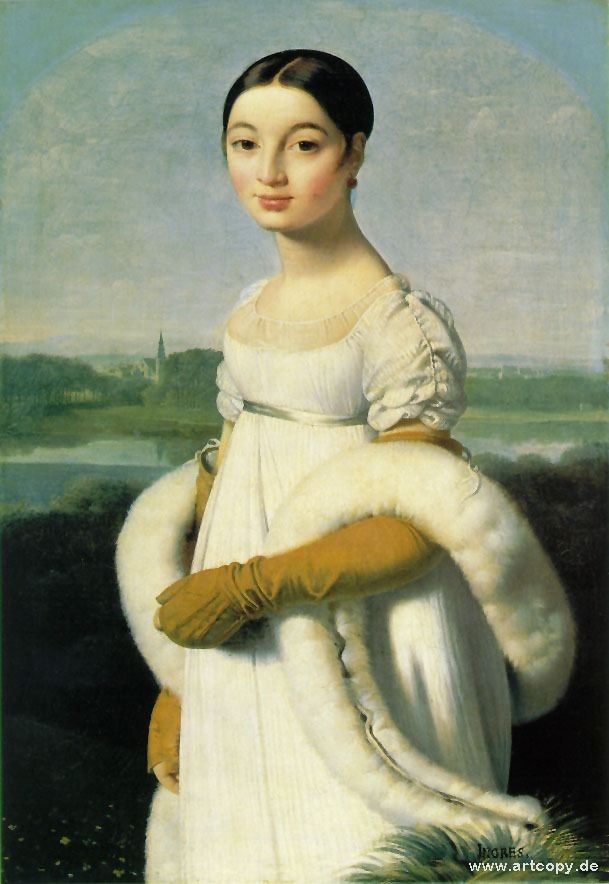
Jean-Auguste Dominique Ingres and Mademoiselle Caroline Rivière

'Mademoiselle Caroline Rivière' (1806) by Jean-Auguste Dominique Ingres;
Musée du Louvre, Paris

Today the choice was easy. French artist Jean-Auguste Dominique Ingres, born on 29 August 1780, is a well-known painter of portraits and oriental subjects. He was actually one of the greatest portrait painters of the 19th century. The son of an unsuccesful painter and sculptor, he studied under Jacques-Louis David in Paris. He won the Prix de Rome for his painting 'The Ambassadors of Agamemnon'. He went to Rome for quite an extensive period (1806-1820) where he developed his style and drawing. His style is influenced by both David and the Italian Renaissance painter Raphael. After Rome he went to Florence and stayed there for four years. Upon his return to Paris, he was very succesful and became the recognised leader of the Neoclassicists. To read more about his life and work, I want to refer you to the link above. Today's painting I find beautiful and it is the third of three portraits of the Rivière family that Ingres painted that year. The other two portraits are of Caroline's father and mother. Early on in his career, Ingres painted commissioned portraits for wealthy patrons. Today's portrait was painted in 1806, before his Rome period. Caroline, the portrayed girl, would have been between thirteen and fifteen years old at the time of the painting. The portrait is seen in the light of tragedy since the sitter died within a year after completion of the work.  

Monday, 9 April 2012

Joseph Karl Stieler and Amalie von Schintling

'Amalie von Schintling' (1831) by Joseph Karl Stieler; Nymphenburg Palace, Munich

Lately I only have been doing posts on famous or well-known painters, so I haven't had the chance to discover a new artist. Today I could have done a post on Dante Gabriel Rossetti, the famous Pre-Raphaelite painter, whose date of death was on this day. But I've decided to postpone him till the 12th of May when it's his date of birth. So today I can do a post on an artist unknown to me. His name is Joseph Karl Stieler, born on 1 November 1781 and died on 9 April 1858, and if you google his name and images, you can see why I like his paintings. They're fine portraits and I love portraits, especially female ones. Although I had never heard of Stieler, there is one portrait that is world-famous and male. It is the portrait of Ludwig van Beethoven and it's the most famous representation of the composer. Stieler's most distinguishing feature in doing portraits was his utter focus on the sitter. He didn't pay much attention to the decor as if not to distract the viewer. He was a court painter and is known for his Neoclassical portraits, especially for the Gallery of Beauties in the Nymphenburg Palace, a portrait gallery of 36 portraits of the most beautiful women of nobility and middle classes of Munich. The portraits were commissioned by King Ludwig I of Bavaria. Click here for further reading on the Gallery of Beauties. It was difficult for me to choose one painting for this post because there are so many beautiful ones but by giving you two links to the gallery (I am so cheating!), you can see all 36 paintings. 

Tuesday, 27 March 2012

Joseph-Marie Vien and The Cupid Seller

'The Cupid Seller' (1763) by Joseph-Marie Vien; Musée National Château de Fontainebleau, Fontainebleau

The depiction of today's painting made me laugh. I simply had to show you this art work of French painter Joseph-Marie Vien, born on June 18, 1716, and died on March 27, 1809. Vien was a former teacher of Jacques-Louis David and considered to be of great importance to Neoclassical art. He created a sensation at the 1763 Salon with the painting shown here. It was based on an ancient Roman wall painting. The women wear dresses reminiscent of classical sculptures and the setting is a classical interior. Cupids were very popular in the 18th century and used frequently in paintings. Vien wanted to imply the idea of bought sexual pleasure. The cupids in the vendor's basket seem harmless infants but the little one held up by the salesgirl seems to hold its forearm in a provocative manner. Anyway, whatever Vien meant with this painting, I think it's cute and funny and I like the colours of the painting very much.