Showing posts with label German painters. Show all posts

Tuesday, 18 December 2012

Karl Becker and The Fireside Story


Karl Becker, born on 18 December 1820

Saturday, 8 December 2012

Thursday, 29 November 2012

Conrad Kiesel and Day Dreaming


Conrad Kiesel, born on 29 November 1846

During the NaNoWriMo Project, I will continue to post a painting a day for the month of November but I won't have time to write. I may add text at a later date. I hope you will still visit to see the daily painting. 

Monday, 12 November 2012

Johann Friedrich Overbeck and Vittoria Caldoni


Johann Friedrich Overbeck, born on 3 July 1789 and died on 12 November 1869

Due to the NaNoWriMo Project, I will continue to post a painting a day for the month of November but I won't have time to write. I may add text at a later date. I hope you will still visit to see the daily painting. 

Tuesday, 23 October 2012

Wilhelm Maria Hubertus Leibl and Farm Girl With A White Head Scarf

'Farm Girl With A White Head Scarf' (1876) by Wilhelm Maria Hubertus
 Leib; Neue Pinakothek, Munich


Not much to choose from today but that made it easier and I found German painter Wilhelm Leibl, born on 23 October 1844, very quickly. He was a Realist painter of portraits and scenes of peasant life. He was one of the most prominent German Realists of the late 19th century. He studied at the Munich Academy and went to Paris to work with Gustave Courbet. His style was in opposition to the Romantic naturalism dominant in Germany at the time. He was an admirer of Dutch old masters and painted with thick brush strokes against dark backgrounds. Apparently, Leibl started to work immediately with colour, without any preliminary sketching, and this resembled the working method of the Impressionists. I quite like his portraits, like the one shown here today. Beautiful colours, and although many of Leibl's paintings are rather dark, this one has a light background and the white scarf makes it a light painting as well. The face looks so fresh like she just came from outside, working the land, with a healthy blush on her cheeks.

Tuesday, 2 October 2012

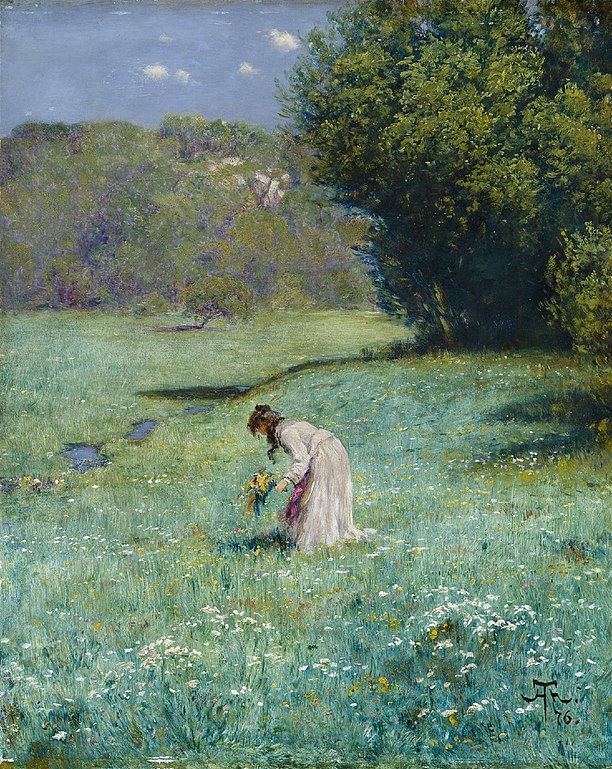
Hans Thoma and Woodland Meadow

'Woodland Meadow' (1876) by Hans Thoma; Hamburger Kunsthalle, Hamburg

There was not so much to choose from today but I am happy to get acquainted with German painter Hans Thoma, born on 2 October 1839. If you click on the Dutch Wikipedia page, you see more images of his paintings and I also like this one very much. Thoma practised various styles but was mainly associated with Symbolism. He studied at the Karlsruhe Academy, went to Paris in 1868 and was influenced by Gustave Courbet and the Barbizon School. His style is difficult to interpret and it's also said that he had affinities with the Pre-Raphaelites. He had attention to detail and loved nature. Today's painting is a lovely depiction of a woman picking flowers. It looks a bit like an Impressionist painting to me. In any case, it makes you long for spring again.

Wednesday, 12 September 2012

Anselm Feuerbach and Iphigenia

'Iphigenia' (1870) by Anselm Feuerbach; Oskar Reinhart Foundation, Winterthur

Anselm Feuerbach, born on 12 September 1829, was a leading German Classicist painter of the German 19th century school. He studied art in Düsseldorf and Münich, then went to Paris where he worked under Thomas Couture and was influenced by Gustave Courbet and Eugène Delacroix. He lived in Italy for a while and many of his best paintings were produced during this period. He was very much interested in Greek and Roman art and antiquity and Italian High Renaissance painting. He painted two versions of Iphigenia, a Greek mythological figure. The first version dates from 1862 (click here) and the second one from 1871 (click here). Today's painting is neither version, but a study of the head for the second version and dates from 1870.

Friday, 20 July 2012

Max Liebermann and The Preserve Makers


Due to my stay and volunteer work in Peru for most of June and July, I won't have time to write but I will continue to post a painting a day. I may add text upon returning to Amsterdam. I hope you will still visit to see the daily painting. 

Sunday, 1 July 2012

Georg Friedrich Kersting and Woman Embroidering


Due to my stay and volunteer work in Peru for most of June and July, I won't have time to write but I will continue to post a painting a day. I may add text upon returning to Amsterdam. I hope you will still visit to see the daily painting. 

Friday, 29 June 2012

Perseus and Andromeda (detail) by Anton Raphaël Mengs


Due to my stay and volunteer work in Peru for most of June and July, I won't have time to write but I will continue to post a painting a day. I may add text upon returning to Amsterdam. I hope you will still visit to see the daily painting. 

Monday, 21 May 2012

Albrecht Dürer and Self-Portrait

'Self portrait' (1500) by Albrecht Dürer; Alte Pinakothek, Munich

German painter Albrecht Dürer, born on 21 May 1471, is amongst others well-known for his lovely depiction of a Young Hare, which I like, but I have decided to post a self-portrait instead. Dürer's early training was in drawing and woodcutting, which he continued to favour over painting throughout his career. He is known for his engravings and for his portraits, the latter mostly commissioned. I chose today's painting (this is a detail, see the full painting here) because I think it's beautiful in detail and it's amazing that this was painted in 1500. I am sort of mesmerised by the beard and the hair!

Monday, 7 May 2012

Caspar David Friedrich and Easter Morning

'Easter Morning' (1833) by Caspar David Friedrich;
Museo Thyssen-Bornemisza, Madrid

It must be evident just by scrolling down the pages of my blog that I prefer portraits over landscapes and still lifes. But I love the work of the German landscape painter Caspar David Friedrich, born on September 5, 1774, and died on May 7, 1840. I do like his paintings of landscapes with solitary figures in them better than the paintings of just landscapes but even the latter ones are stunning. His landscapes are desolate and seem to tell a story. I have been to Die Alte Nationalgalerie in Berlin some years ago and they have a room dedicated to Friedrich. Upon entering it, you get immediately drawn in by the light in his dark paintings. In 2008, I saw a small Friedrich exhibition in the Hermitage, Amsterdam, and I experienced the same. Friedrich was one of the greatest Romantic painters of the symbolic landscape. He studied in Copenhagen and settled in Dresden afterwards. His paintings are beautiful observations of nature based entirely on landscapes in northern Germany. He used people in his paintings to emphasize nature's vastness and they appear with their backs to the viewer, lost in contemplation. He also wanted to show man at the mercy of the elements. It could be that his dark paintings reflect a tragedy from his childhood. When he was 13 years old, he fell through the surface of a frozen lake and was almost killed. His brother drowned in the effort to save his life. 

Friday, 20 April 2012

Franz Xaver Winterhalter and Madame Barbe de Rimsky-Korsakov

'Madame Barbe de Rimsky-Korsakov' (1864) by Franz Xaver Winterhalter; Musée d'Orsay, Paris

It's quite evident why Franz Xaver Winterhalter, born on 20 April 1805, was such a well loved portrait painter, especially at the royal court. One of his most famous portraits is the one of Empress Elisabeth of Austria, whom you might know as Sissi. As you may remember or maybe not, I've already done a post on a painting by Winterhalter but that was a painting of a historical event matching the date of that post. I probably could have chosen another painter for today but I wanted to show you a woman's portrait by Winterhalter, because I love the depiction of the fine details of fabric and hair. Although the serious critics thought his work was superficial and artistically inadequate, his patrons appreciated his work and he got many commissions by royal families to paint portraits. Superficial or not, I think this portrait of Madame Barbe de Rimsky-Korsakov is beautiful, more beautiful than Winterhalter's Sissi.

Monday, 9 April 2012

Joseph Karl Stieler and Amalie von Schintling

'Amalie von Schintling' (1831) by Joseph Karl Stieler; Nymphenburg Palace, Munich

Lately I only have been doing posts on famous or well-known painters, so I haven't had the chance to discover a new artist. Today I could have done a post on Dante Gabriel Rossetti, the famous Pre-Raphaelite painter, whose date of death was on this day. But I've decided to postpone him till the 12th of May when it's his date of birth. So today I can do a post on an artist unknown to me. His name is Joseph Karl Stieler, born on 1 November 1781 and died on 9 April 1858, and if you google his name and images, you can see why I like his paintings. They're fine portraits and I love portraits, especially female ones. Although I had never heard of Stieler, there is one portrait that is world-famous and male. It is the portrait of Ludwig van Beethoven and it's the most famous representation of the composer. Stieler's most distinguishing feature in doing portraits was his utter focus on the sitter. He didn't pay much attention to the decor as if not to distract the viewer. He was a court painter and is known for his Neoclassical portraits, especially for the Gallery of Beauties in the Nymphenburg Palace, a portrait gallery of 36 portraits of the most beautiful women of nobility and middle classes of Munich. The portraits were commissioned by King Ludwig I of Bavaria. Click here for further reading on the Gallery of Beauties. It was difficult for me to choose one painting for this post because there are so many beautiful ones but by giving you two links to the gallery (I am so cheating!), you can see all 36 paintings. 

Monday, 26 March 2012

Julius Schnorr von Carolsfeld and Bathsheba

'Bathsheba at her bath' (1820-25) by Julius Schnorr von Carelsfeld; can't find location

It was a bit difficult to find a painting for today. Not many that I really liked. Then I came across the German painter Julius Schnorr von Carolsfeld, born on 26 March 1794. He was a member of the Nazarene movement, a group of German Romantic painters 'who aimed to revive honesty and spirituality in Christian art' (quote from the Wikipedia page). The formation of the movement was a reaction against Neoclassicism and their aim was to restore the purity of form found in Renaissance art. Most of their work had biblical themes. I chose this painting of Bathsheba (with a strong Neoclassical influence!) because I think it is beautiful and I was curious about the story behind it. My biblical knowledge leaves a lot to be desired. And I was wondering about the man on the rooftop! Well, he is David and the story of his seduction of Bathsheba is told in 2 Samuel 11. He was walking on the roof of his palace and saw Bathsheba, the wife of Uriah, bathing. He desired her and made her pregnant. If you want to know the full story, either grab the bible or click here.

Wednesday, 15 February 2012

Karl Friedrich Lessing and the Mourning Royal Couple

'Mourning Royal Couple' (1830) by Karl Friedrich Lessing; State Hermitage Museum, St. Petersburg

Last week I had already searched for a painter for today and found Karl Friedrich Lessing (15 February 1808 - 4 January 1880). The weather here in Amsterdam was real wintery then, with freezing cold nights and a layer of snow covering the city. The painting I had initially chosen for this post was a wintery scene of a monastery and courtyard covered in snow because I liked the painting. Then I read that Lessing was a German landscape painter who later devoted himself to historical paintings and found out that 'Mourning Royal Couple' is one of his most famous works. So since the snow has melted here and since I like portraits better than landscapes (although 'Monastic yard in the snow' is really beautiful), I have decided to show you a painting of a royal couple mourning the death of their daughter. I did a quick search on the internet in order to find out whether this was indeed a historical couple, but couldn't find anything. 

Sunday, 22 January 2012

King Edward VII by Franz Xaver Winterhalter

'Albert Edward, Prince of Wales' (1846) by Franz Xaver Winterhalter; Royal Collection, St. James's Palace, London

No noteworthy artists born or died on this day, as far as I could find, so I've chosen a historical event. On January 22, 1901, Edward VII was proclaimed King after his mother, Queen Victoria, died. The painter Franz Xaver Winterhalter, who had been appointed court painter of the King of France, made a portrait of Edward (he was christened Albert Edward) when he was a child. I quite like this portrait and have liked Winterhalter ever since I have visited the opening exhibition in the Hermitage Amsterdam, 'At the Russian court'. His portrait of Countess Varvara Musina-Pushkina was part of the exhibition and had been used for promotional material.

Monday, 16 January 2012

Arnold Böcklin and Summer's Day

'Summer's Day' (1881) by Arnold Böcklin; Galerie Neue Meister, Dresden

Arnold Böcklin (16 October 1827 - 16 January 1901) is best known for his masterpiece 'Isle of the Dead'. I've decided not to use this painting here because I've already used it in a post on my other blog. I struggled a bit to find another work by Böcklin that I like since 'Isle of the Dead' is so impressive and unsurpassable. But I was thinking that maybe I wouldn't even have liked 'Isle of the Dead' so much if I wouldn't have seen it in real life in Die Alte Nationalgalerie in Berlin. It had made a huge impression on me then. Böcklin is a symbolist painter and a lot of his paintings I find too depressing and eerie. I've chosen the painting 'Summer's Day' because of the bright blue sky, the large trees and the depiction of what looks like children playing. Beautiful colours and water reflections. But although it looks quite innocent, it also has an ominous feel to it so it might not be what it looks like.

Sunday, 15 January 2012

Gustav Adolph Hennig and The Reading Girl

'Reading Girl' (1828) by Gustav Adolph Hennig; Museum of Fine Arts, Leipzig

I've started using other methods to look for painters to match the days of the calendar because the search on Wikipedia and the internet wasn't satisfying enough. So I took my numerous art books from the shelf and began to look for images of nice paintings. Next step would be to go on the internet and look for the actual date of birth or death of the painter. So I came across this wonderful painting by an artist unknown to me, Gustav Adolph Hennig, born on 14 June 1797 and died on the 15th of January, 1869. The simplicity of Hennig's portrayal of a girl reading is what makes this such a strong painting. I love this! Wikipedia doesn't have an English page on the artist so I hope you read German. 

Tuesday, 3 January 2012

August Macke and Portrait of the Artist's Wife

'Portrait of the Artist's Wife' (1909) by August Macke; Westphalian State Museum of Art and Cultural History, Münster

I didn't really know August Macke's work. I knew him to be a member of the German Expressionist Group Der Blaue Reiter but I was unaware of the beauty of some of his paintings until now. I had to choose one image but I could have chosen numerous ones. I really like his paintings of women. In that respect he reminds me a bit of Kees van Dongen. Macke was born on 3 January 1887 and died an early death at the front in the second month of World War I, in September 1914.