Wednesday, 31 October 2012

Johannes Vermeer and Girl With A Pearl Earring

'Girl With A Pearl Earring' (c. 1665) by Johannes Vermeer; Mauritshuis, The Hague

I guess on the list of most famous Dutch painters, next to Rembrandt and Van Gogh, ranks Johannes Vermeer, baptised on 31 October 1632 (no record of his actual date of birth). His Girl With a Pearl Earring is his masterpiece and world famous, sometimes referred to as 'The Dutch Mona Lisa'. To see it in closer detail, click here and once again to enlarge it. It is indeed beautiful, but not my favourite painting by Vermeer and also not my favourite painting of the collection of the wonderful Mauritshuis in The Hague. I have visited the museum numerous times now and can recall the first time I saw the Girl with the Pearl Earring. I thought it was beautiful but I was also a bit disappointed. It is such a famous painting that when I looked at it for the first time in real life, it didn't hold any surprises. It was just the way I had seen it in art books and reproductions. This might sound terrible to art connoisseurs but that's how I experienced it. The blue wasn't more startling (Vermeer preferred to use cool tones of blue), nor the intimate look in the girl's eyes. For instance, I find a Rembrandt painting always a bit of a surprise seeing it in real life, because his dramatic use of light can never be matched in a reproduction. Anyway, I hope I didn't offend any fervent fans of this particular painting. About the man himself, I only want to mention the following and the rest you can read by clicking on his name above. Vermeer was known for his paintings of domestic interior scenes of middle class life and only produced forty or so paintings. He stayed relatively unknown during his brief lifetime and it wasn't until the 19th century that he got recognition and appreciation for his work. Of course I could have chosen another painting by Vermeer, like Diana and Her Companions (also to be seen at the Mauritshuis) or the The Milk Maid or the beautiful The Lacemaker, all of which I like better than the Girl with the Pearl Earring. But I guess I want to post this masterpiece to appreciate its beauty more. Click here for a list of Vermeer's paintings.
Tuesday, 30 October 2012

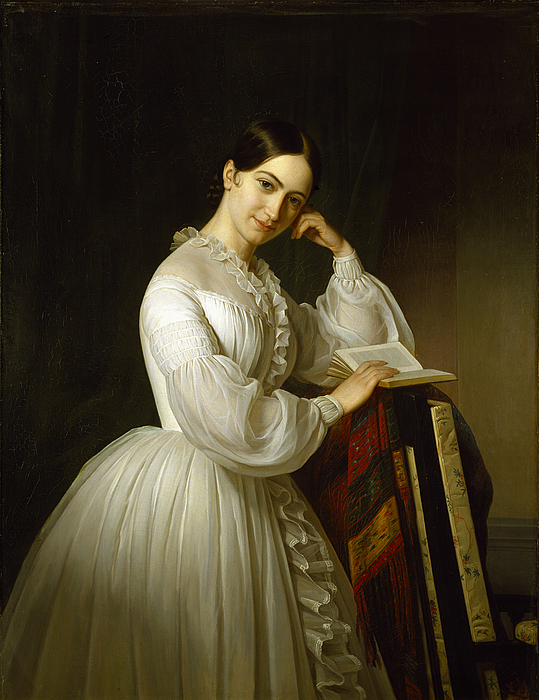
Emilius Ditlev Bærentzen and Portrait of the Actress Johanne Luise Heiberg

'Portrait of the Actress Johanne Luise Heiberg' (1841) by Emilius Ditlev Bærentzen; Thorvaldsens Museum, Copenhagen

I found a Danish painter for today, Emil Bærentzen, born on 30 October 1799. He was a portrait painter and active during the Golden Age of Danish Painting. He studied at the Danish Academy and soon became one of Copenhagens's leading portraitists. His paintings were characterised by a sober style, like today's painting. The dress is elegant but simple, and all attention is being drawn to the woman's face and her smile. Bærentzen was commissioned by Bertel Thorvaldsen to do a portrait on the famous Danish actress Johanne Luise Heiberg. With this commission, Thorvaldsen would have a portrait of his favourite actress ánd a painting by Bærentzen in his collection. The painting is to be seen at the Thorvaldsens Museum in Copenhagen. I have done a post on another Danish painter, Wilhelm Marstrand, who also painted a portrait of the actress. Click here and see which one you like better (I like the Marstrand one better).

Monday, 29 October 2012

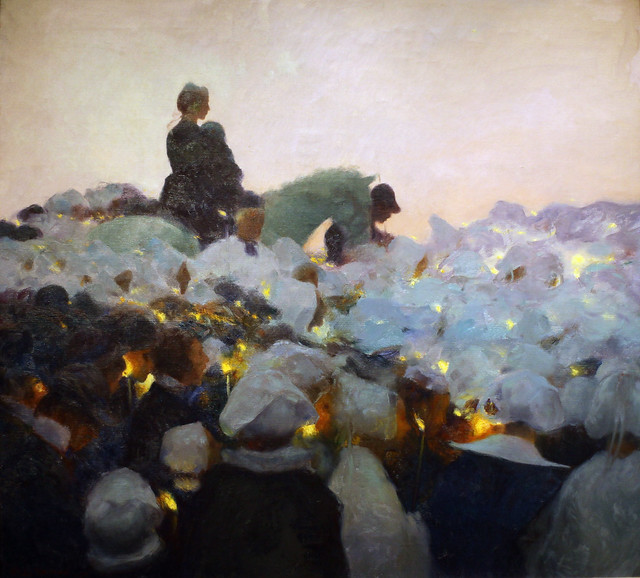
Gaston La Touche and Pardon in Brittany

'Pardon in Brittany' (1896) by Gaston La Touche; Art Institute of Chicago, Chicago

The reason why today's painting by French painter Gaston La Touche, born on 29 October 1854, caught my eye while browsing the net, will be clear just by looking at the image. The light of the glowing candles is beautiful and I immediately wanted to know what scene is being depicted in this painting. I will come to that in a minute. La Touche was a Post-Impressionist painter whose first paintings were of working-class Parisians, done in a depressing style. He made the acquaintance of Edgar Degas and Édouard Manet and wished to study art with the latter. Manet refused him as a student and said there was nothing he could teach him. La Touche just needed to use a variety of colours and paint what he saw. Another friend of his, Félix Bracquemond, advised him to paint in the style of Watteau and Fragonard, who were known for their dreamy subjects, soft pastels and light themes. La Touche took the advice and burned almost all of his old paintings. He sought out scenes of beauty to suit the lighter mood of his new paintings and ended up in Brittany, on the northwest coast of France. Here, on the feast days of patron saints, were processions of pilgrims in traditional dress. The pilgrimages were called Pardons and the pilgrims would seek forgiveness. Together they walked in prayer and a priest granted them absolution. Which brings us to today's painting. We see a man leading a horse with a woman and child. It's almost as if the horse is suspended in space amongst a carpet of white lace bonnets. In front of the horse, the priest receives the penitents holding their candles. Although the scene is crowded, there is a quiet peacefulness to it. I think it's nice to know the story of a narrative painting. It sometimes makes you look at a painting differently. But with this painting, I think the main character is still the beautiful light of the glowing candles. The artist's English Wikipedia doesn't give much information, so I used this article.

Sunday, 28 October 2012

Lowell Birge Harrison and November

'November' (1881) by Lowell Birge Harrison; Musée des Beaux-Arts, Rennes

Today's painter, Lowell Birge Harrison, born on 28 October 1854, and his painting November, I know from the exhibition Illusions of Reality (8 October 2010 - 16 January 2011) at the Van Gogh Museum in Amsterdam. I thought it was one of the most beautiful paintings of the exhibition. Large in size and beautiful in colour, my gaze was drawn to it the moment I walked into the room. November is drawing near on the actual calendar so this painting might put you in the mood for an autumn walk in the woods. Before the exhibition, I had never heard of Harrison. He was an American painter and an advocate of Tonalism. In the 1870s, he met John Singer Sargent who persuaded him to come to Paris to study art. He stayed there for six years and exhibited at the Paris Salon with his painting 'November' in 1882. It became one of the first paintings by an American artist to come into the possession of the French government. Harrison was known for his poetic winter landscapes and street scenes. When you google the images of his paintings, there are many that are beautiful. Like Grand Central And The Biltmore In Hazy Twilight and Moonlight River and Fifth Avenue at Twilight. Please click here for more.

Saturday, 27 October 2012

Charles Spencelayh and Helping Mother

'Helping Mother' (1899) by Charles Spencelayh; Private Collection?

I had never heard of English painter Charles Spencelayh, born on 27 October 1865. Judging from the length of his Wikipedia page, he seems to be a minor painter. Today's painting of a girl helping her mother immediately caught my eye. I think it is quite stunning because of its photographic quality and because the girl's face looks so modern. I also find that it could be two paintings, namely a portrait and a still life. Because both depictions in this painting are strong enough to stand on its own. Just imagine the girl without the food in front of her and the other way around. Do you see what I mean? Spencelayh was a painter in the Academic style and exhibited at the Paris Salon but more often in Britain. He painted domestic scenes, still lifes and portraits. I couldn't find the location for today's painting but found that it sold at Christie's in 1999 for 45,500 GBP.

Friday, 26 October 2012

William Hogarth and Sigismunda Mourning over the Heart of Guiscardo

'Sigismunda Mourning over the Heart of Guiscardo' (1759) by William Hogarth;
Tate Britain, London

I couldn't really make a choice today and I had initially dismissed English painter William Hogarth, born on 10 November 1697 and died on 26 October 1764. I'm not a big fan of his work but when I saw this painting of Sigismunda, I had to doublecheck its painter because it doesn't look like a Hogarth painting at all and I like it. The Tate says about this painting: "This was Hogarth's most deliberate attempt to prove that modern English painters could handle heroic themes as convincingly as the revered Italian old masters." Although Hogarth had expressed his distaste for the old Renaissance masters, he copied their style for this painting. It's a depiction of a dramatic scene from Boccaccio's Decameron. Sigismunda clutches the golden cup to her heart, sent to her by her father. Inside the cup is the heart of her dead husband Giuscardo, one of her father's servants. Distraught at the death of her beloved husband, she puts poison in the cup and kills herself. Hogarth had to endure harsh criticism for this painting and almost abandoned painting altogether for the last years of his life. For more information, click here.

Thursday, 25 October 2012

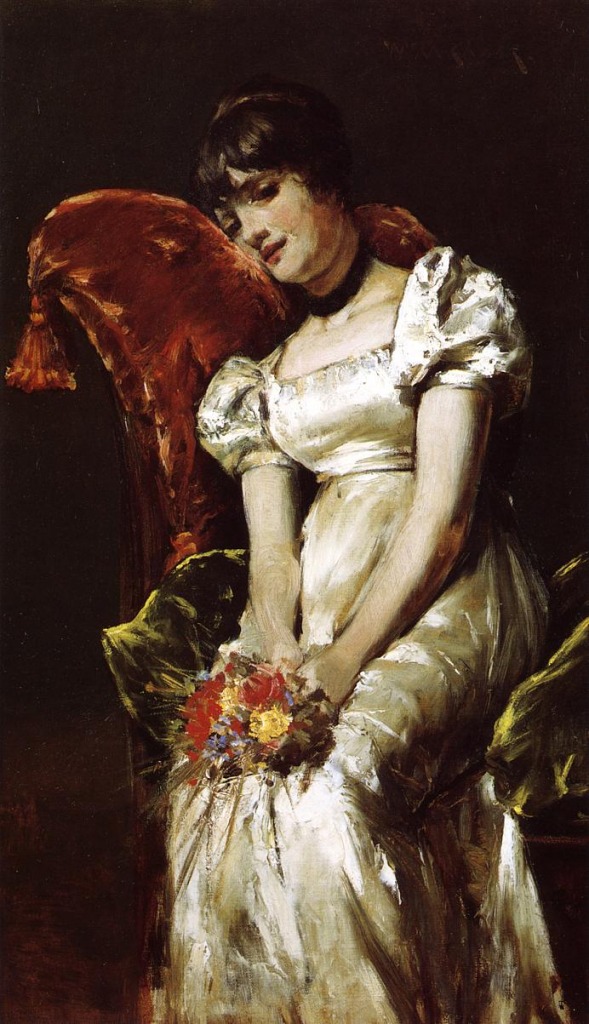
William Merritt Chase and Young Girl with Flowers

'Young Girl with Flowers' (1885) by William Merritt Chase; Palacio Real, Madrid

When you google the paintings of American Impressionist artist William Merritt Chase, born on 1 November 1849 and died on 25 October 1916, you see still lifes, women portraits, women set in landscapes and lush interiors, some paintings of men and children. It is his portraits that he is best known for. I didn't know him before doing this blog, but I have come across his name and paintings so often now that it only feels natural to dedicate a post to him, also because I like his work. He studied art in New York, but it was at the Royal Academy of Fine Arts in Munich where he received his most decisive training. When he returned to New York, he began teaching. He had adopted the plein air method of painting and often taught his students in outdoor classes. He devoted much of his time and energy to teaching and even opened the Chase School of Art in 1896. Two years later it became the New York School of Art. Chase was the most important art teacher around the turn of the 20th century. Many well-known American artists like Georgia O'Keeffe have studied under Chase. For today I have chosen a beautiful portrait of a young girl with flowers. I love the dark background and the contrasting red and green and multiple colours of the bouquet. There's no particular reason why I have chosen this painting when there are so many other paintings that I like and could have chosen. I will provide you with a link, click here, so you can see his other paintings as well. Enjoy!

Wednesday, 24 October 2012

Jan Lievens and Study Of An Old Man

'Study Of An Old Man' (c. 1629) by Jan Lievens; Private Collection
 
There were two Dutch painters to choose from today. Jan Lievens, who was born on 24 October 1607, and Gabriël Metsu, buried on the 24th of October, 1667. They were even contemporaries. I just read their biographies online and found out that they were both born in Leiden. Lievens died in Amsterdam and Metsu was buried there (there's no information on the date or location of his death). As much as I like Metsu and in particular this painting of a Man Writing a Letter, I choose Jan Lievens for this post. If you follow this blog, you get a sense of what paintings I like and lots of times those are of beautiful women. But I also love paintings of old men, in the way that Ribera and Rembrandt have painted them. Of course Rembrandt was the master in painting old men (I love this painting) but today's painter Lievens comes very close. You will notice similarities between Lievens and Rembrandt and this is not surprising since Lievens was a student of Pieter Lastman who was Rembrandt's teacher. Lastman paid a lot of attention to painting features like hands, feet and faces, and these are also very apparent in the paintings of Lievens and Rembrandt. Lievens shared a studio with Rembrandt from about 1626 till 1631 in Leiden and they became friends. I have visited the exhibition on Jan Lievens at the Museum Het Rembrandthuis in Amsterdam in 2009, and it was actually the first time that I got introduced to his work. Today's painting of a study of an old man, he probably painted in 1629, when he and Rembrandt were making studies on old age. I think it is beautiful. It was put up for auction at Sotheby's in London in 2010, together with a painting by Frans Hals. The estimated price for both paintings was between 2,25 and 3,37 million euros.

Tuesday, 23 October 2012

Wilhelm Maria Hubertus Leibl and Farm Girl With A White Head Scarf

'Farm Girl With A White Head Scarf' (1876) by Wilhelm Maria Hubertus
 Leib; Neue Pinakothek, Munich


Not much to choose from today but that made it easier and I found German painter Wilhelm Leibl, born on 23 October 1844, very quickly. He was a Realist painter of portraits and scenes of peasant life. He was one of the most prominent German Realists of the late 19th century. He studied at the Munich Academy and went to Paris to work with Gustave Courbet. His style was in opposition to the Romantic naturalism dominant in Germany at the time. He was an admirer of Dutch old masters and painted with thick brush strokes against dark backgrounds. Apparently, Leibl started to work immediately with colour, without any preliminary sketching, and this resembled the working method of the Impressionists. I quite like his portraits, like the one shown here today. Beautiful colours, and although many of Leibl's paintings are rather dark, this one has a light background and the white scarf makes it a light painting as well. The face looks so fresh like she just came from outside, working the land, with a healthy blush on her cheeks.

Monday, 22 October 2012

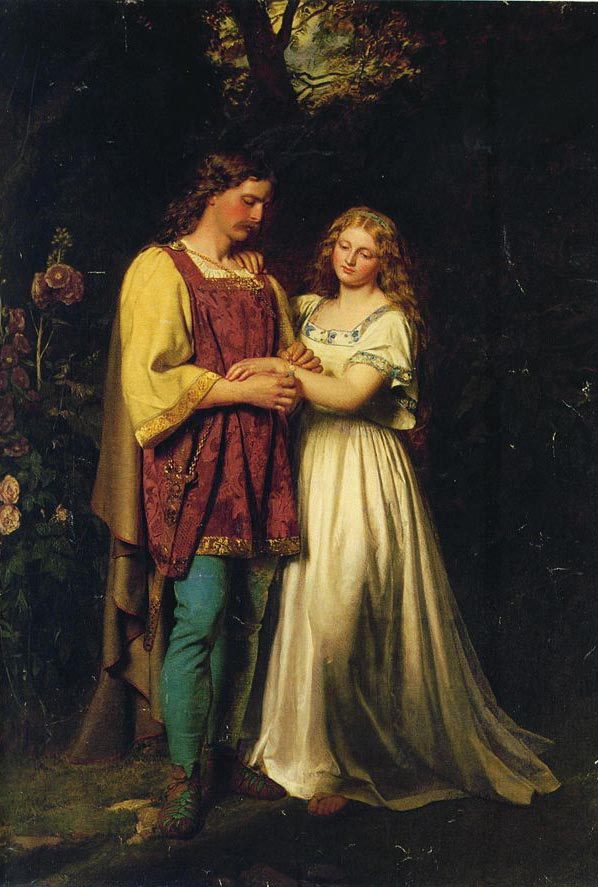
John Faed and Posthumus and Imogen

'Posthumus and Imogen' (c. 1865) by John Faed; Private Collection?

I didn't look any further beyond the first painter on my list to check out for paintings. Scottish artist John Faed was born on 31 August 1819 and died on 22 October 1902. I instantly liked this painting, although it is rather sweet. But the colours are beautiful and I like the romantic depiction. It is a scene from Shakespeare's Cymbeline. Posthumus has secretly married Imogen, the daughter of the King of Britain, Cymbeline, and the moment depicted here is when he has been banished from Cymbeline's kingdom. He gives Imogen a bracelet in return for a ring of hers, with the promise to come back to her (click on the links provided to read the full story). The painting sold at Christie's in London in 2007 for $38,073. Faed mainly painted historical, religious and literary scenes.